
The Raoul Wallenberg International Roundtable Guy von Dardel Memorial Meeting Budapest May 20-21 2016 Stockholm 13-15 September 2017 Complementary text 2019
Bo Theutenberg,
Ambassador (ret), Professor of International law Former Chief Legal Adviser to the Swedish Foreign Ministry
Sweden’s Social Democratic legacy that sealed Raoul Wallenberg’s fate – Gordievsky’s book ‘A blind mirror’
In order better to understand the title of my presentation, I must give some background information. It is a challenging title dealing with the core of Sweden’s Social Democratic Party’s policy in relation both to the Soviet Union and “the West”, including NATO and the United States. Raoul Wallenberg, born August 4, 1912, was only 32 years old when he, as a Swedish diplomat, on January 17, 1945 was detained by the Soviet military forces advancing towards Budapest – and then disappeared into the Stalinist prison system characterized by total lack of justice and respect for human lives. Although the Soviet Union (later Russia) maintained that he had died on July 17, 1947 in Moscow’s notorious Internal (Lubyanka) Prison – which also served as headquarter for the Soviet State Security Services, (NKVD,
SMERSH and MGB/KGB.– nobody knows his real fate. What a nightmare for his parents and his relatives, to live with the loss and the uncertainty, decade after decade.
When I myself, 24 years old, joined the Swedish diplomatic corps as an attaché in 1966, I did not know very much about Raoul Wallenberg. When I was sent to work at the Swedish Embassy in Moscow, as a First Secretary, between 1974 and 1976, I became more and more interested in Raoul Wallenberg’s fate. Frequently I passed by the Lubyanka Prison, always paying silent tribute to this fellow-diplomat, who – as I gradually came to understand – was totally abandoned by his own employer, the Swedish Ministry of Foreign Affairs (UD), and his own government.
At the time of his disappearance in January 1945, the wartime four-party coalition under the Social Democratic leader Per Albin Hansson was still in office, with the career diplomat Christian Günther as Foreign Minister. After the end of World War II, this coalition government was replaced on July 31,1945 by a pure Social Democratic government with Per Albin Hansson as Prime minister and Professor Östen Undén as Foreign Minister. After Per Albin Hansson’s sudden death on 6 October 1946, the newly elected Social Democratic leader Tage Erlander succeeded him as Prime Minister. Östen Undén served alongside Erlander as Minister for Foreign Affairs, the post he kept for seventeen years, until 1962.
Actually Undén was also the Chief Legal Adviser in International law at the Foreign Ministry (UD:s Folkrättssakkunnige), which post he held for twenty-six years (1920-1924 and 1946- 1961). For almost seven decades (1919 – 1987) this was an important and independent position at the ambassadorial level, attached directly to the Offices of the Foreign Minister and the Secretary General of the Foreign Ministry (UD:s kabinettssekreterare), to whom the Chief Legal Adviser reported.
I myself was serving as the Ministry’s Chief Legal Adviser in international law for a decade (1976 -1987), when I in 1987 resigned from the post, as a protest against what I considered the Social Democratic government’s pro-Soviet policy. I could not let my name be connected with the Swedish Government ́s “policy of indulgence” towards the Communist Soviet Union. Therefore I chose to resign. The soft or even non-existent Swedish reaction to Raoul Wallenberg’s disappearance in 1945 was an integral part of the general “Swedish paralysis” in
relation to the Soviet Union.
It is the Foreign Minister (and the Chief Legal Adviser) Östen Undén that has had to bear the heaviest accusations and criticism for not doing enough to help his own employée (Raoul Wallenberg) in light of the Soviet Union’s unacceptable treatment of a Swedish diplomat and for not pursuing a harder line against the Soviet leadership. Undén has been accused of initiating the so called ”policy of accommodation” (Eftergiftspolitik) towards the Soviet Union; that is say, to do nothing that could provoke or upset Stalin and the Soviet Union. He became the “founding father” of Sweden’s strict policy of neutrality, which instead – somewhat ironically – was characterized by a close secret military and intelligence cooperation with Western powers. I know this first-hand, since I served in the military forces during the years 1965- 1988.
Although formally neutral in times of war, Sweden would in fact cooperate closely with the United States and NATO. This was the real truth behind the Swedish official declaration of neutrality, which of course led to great Soviet suspicions against Sweden’s officially neutral status. Even though a close military cooperation between Sweden and the United States came to develop from 1952 and onwards, Soviet suspicions of planned future Swedish-U. S.- cooperation could have influenced the Soviet detention of Raoul Wallenberg in Hungary already in January 1945. The rumoured accusations of espionage may have been a contributing factor to rendering Sweden “mute” in its first reactions to Stalin and the Soviet Union when trying to find out Wallenberg’s fate after his detention in 1945 (see below).
In 1976, fourteen years after Östen Undén’s resignation in 1962, I was myself appointed to the post as the Chief Legal Adviser to the Foreign Ministry. Since I also had a parallel military career, with regular service in the Swedish Air Force, and – from 1976 onwards – at the Defence Staff (Operational Section Op 2 that also handled intelligence matters during that time), I had an excellent insight into the extremely sensitive intelligence sphere, not least in relation to the Soviet Union and its espionage and intelligence bodies, like the KGB , GRU (Main Intelligence Directorate, Glavnoye Razvedyvatel’noye Upravleniye), the International Department of the CPSU (Communist Party of the Soviet Union) Central Committee and so forth. I knew quite a lot about Soviet espionage, infiltration and disinformation during the Cold War, which was as heavy as it is today under the current Putin regime.
The remarkable double standards of the so-called Swedish neutrality – both “neutral” and “non-neutral” – “allied” and “non-allied” – led to extreme caution in all Swedish actions in relation to the Soviet Union, often even to a total stand-still, where Sweden did not dare to express itself in any firmer way. A too strong position on various matters – including a demand for clarification of the disappearance of Raoul Wallenberg – could have led to the disclosure of Sweden’s difficult strategic and military position.
This muted policy resulted in what I would call a Swedish “non-position” with regard to a possible Swedish participation in the North Atlantic Treaty Organisation (NATO). In 1949, two of Sweden’s neighbours, Denmark and Norway, became founding members. At the same time, Stalin had forced Finland into the 1948 Friendship- and Cooperation Pact with the Soviet Union, which lasted until 1992. Even though the United States and NATO helped Sweden to build up its military defence into one of the strongest forces in Europe, Sweden (or rather Foreign Minister Östen Undén) did not dare to officially join the Western Defence Pact. This total paralysis in relation to NATO has continued for 70 years, still making it impossible for Sweden formally to choose NATO – for fear of incurring “Russia’s revenge”.
During my decade as the Swedish Foreign Ministry’s Chief Legal adviser (1976-1987), I participated in the management of nearly all crises that occurred during that time, mostly involving Sweden and the Soviet Union. I helped manage the incident involving a Soviet submarine U 137 in October-November 1981 in the Karlskrona archipelago, as well as responding to the Soviet submarine activities in Hårsfjärden in the Stockholm archipelago in October 1982. Among other things, I authored the text of the two official notes that were handed over to the Soviet Ambassador on November 5, 1981 and April 26, 1983 respectively,
protesting against these intrusions into Swedish territory. During 1985-1987, I also led the exploratory talks with the Soviet Union concerning the delineation of the Economic
Zones east of Gotland in the Baltic Sea (the so called ”White Zone Area”), which led to a number of incidents during the years before the matter was resolved.
Thus I had a first-row seat regarding the tensions that existed between Sweden and the Soviet
Union. On some occasions the unresolved matter of Raoul Wallenberg’s fate entered into the management of the Swedish-Soviet crisis. I am mentioning one of these occasions in Volume 1 of my memoirs Dagbok från UD (“Diaries from the Foreign Ministry”), which is based on my daily diaries.
In my notes, I describe the heated conversation between the Swedish Foreign Minister, Ola Ullsten (Liberal party), and the Soviet Ambassador Mikhail Jakovlev in October 1981, when a Soviet submarine had run aground in Swedish internal waters, outside of Karlskrona. The conversation was directly related to the troubling indications that the stranded submarine had nuclear missiles on board. Right here – just in the midst of the discussion about nuclear weapons on board the submarine – I make a special point in my diaries to underline that it was suggested by some parties that Sweden should utilize the submarine U-137 and its crew in a bargain to have Raoul Wallenberg released – or at least to utilise the detained submarine to press for further information about the fate of Raoul Wallenberg. This occurred in 1981, which meant that Raoul Wallenberg, if he was still alive, would have been 69 years old.
It is exactly this note in my diaries – which are written in Swedish – about the possibility of an exchange between the Soviet submarine and Raoul Wallenberg that gave reason for Susanne Berger to contact me regarding the Swedish reasoning behind the idea of an exchange and what happened to this idea. Her first email to me asking these questions is dated 12 November 2014, about the same time as she published the report “An Inquiry steered from the Top?, Twenty-five years later, still many loose ends in three major Cold War Cases”?”, analysing the shortcomings of the research so far made within the sphere of “lost Swedes in Soviet prisons “. It is not only Raoul Wallenberg that was lost in the Soviet/Russian detention camps and prisons, but also other Swedes, like crewmembers of fishing boats that disappeared in the Baltic. She also mentioned that she had been working as a consultant to the Swedish- Russian Working Group that investigated the case 1991-2001, a most important document.
As early as 1990-91, an international commission, led by Raoul Wallenberg’s half-brother, Professor Guy von Dardel, working closely with Russian experts and officials, was able to confirm that both Raoul Wallenberg and his driver Vilmos Langfelder had been imprisoned in the Soviet Union during the years 1945 -1947. They were both brought from Budapest to Moscow in January 1945.
Later, a bilateral Swedish-Russian Working Group that investigated the Wallenberg case from 1991 until 2000 managed to expand on these findings, but concluded its investigation without obtaining full clarity about Wallenberg’s fate. Unfortunately, many of the documents released by the Russian side of the Working Group were heavily censored and important collections remained altogether inaccessible for most researchers. Among other things, these documents raise the important question if Raoul Wallenberg could have been held as “Prisoner no. 7” in the Lubyanka Prison in 1947; and if he possibly remained there some time after July 17, 1947, his alleged date of death, according to Soviet authorities. The whereabouts of “Prisoner no 7” has then become a main factor for the continuous Wallenberg research.
Upon receiving Susanne Berger’s email on 12 November 2014 I informed her about the background of this “short episode” that occurred on 2 November 1981 where Raoul Wallenberg’s name popped up in the midst of the acute crisis management of the Soviet submarine.
Should Sweden choose to involve Wallenberg into the crisis management, which already was extremely dangerous and complex and really could have led to an armed confrontation between Swedish and Soviet military forces, the latter prepared to penetrate into Swedish waters and release the submarine by force? I felt at the time that some effort should be made nevertheless to press the Soviet side for information about Wallenberg’s fate, even in this difficult situation. However, the Swedish Foreign Ministry decided that the question of Wallenberg’s fate should be pursued strictly through official diplomatic channels.
I noted this statement in my diary:
‘Absolutely not, says the Swedish Foreign Ministry! We cannot take the submarine and its crew hostage, meaning we cannot counter one violation (taking Wallenberg) with another (taking the submarine hostage). This supposedly goes against the idea we have of ourselves as a society based on laws’, it is
stated pompously. Who the h-ll has written this?” [Fig. 15]
As my frank comment shows, I did not agree with the official position taken by the Ministry’s Legal Department (which obviously had written this ill-formulated paper), ”to do nothing”. [Fig.1]
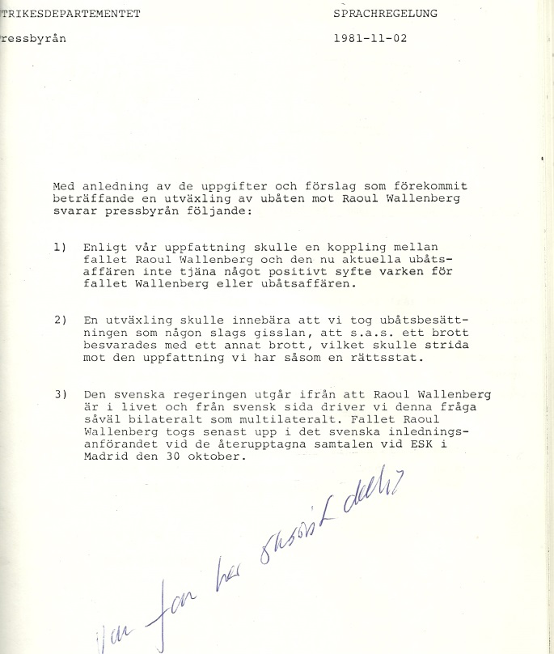
Fig. 1. Official internal ”Talking Points”(Sprachregelung) issued by the Swedish Foreign Ministry’s Press Department in 1981, rejecting requests to use the incident of a stranded Soviet submarine outside of Karlskrona to elicit information about Raoul Wallenberg’s fate from the Soviet government. The copy shows a handwritten note by the Swedish Foreign Ministry’s Legal Advisor at the time, Bo Theutenberg, who strongly disagreed with the decision. The note reads: ”Who the h..l has written this?”
This was the general trend in the Ministry when it was led by Social Democratic ministers, who, as I said earlier, became ideologically muted or downright paralyzed with regards to everything that pertained to the Communist Soviet Union, a country that many of them really liked, as they also basically liked the Marxist-Leninist or Communist ideology that was the basis for the existence of the Soviet Union.
This was, for instance, very much the case for the former Swedish Foreign Minister Östen Undén, who must be described as quite left on the ideological spectrum. His wish/hope was to serve as a kind of “bridge-builder” between East and West, creating a ”middle way” between communism and capitalism. Consequently, he was not pleased to encounter obstacles to such a noble cause, preventing him to pursue the creation of this new ”middle way”. The strange thing is that he did not recognize the advantages of democracy and thus regarded the two systems as alike. In Swedish we refer to this as “kålsuparteorin” (“cabbage soup theory”) – which suggests that one system is as good as the other.
One really feels chilling fright upon discovering that Östen Undén basically viewed the Raoul Wallenberg as such an “unwanted obstacle” in his way. When, for instance, Undén for the first time met the Soviet Foreign Minister Vyacheslav Molotov at the United Nations in New York on November 21, 1946, i.e. when Wallenberg was still alive in the Soviet prison system, Undén choose not to bring up the case of Wallenberg at all, a most astonishing behavior of the Swedish Foreign Minister. Instead, it was the Trade- and Credit Agreement between Sweden and the Soviet Union, an extremely generous Swedish gesture to the Communist Soviet Union, that the two men discussed.
I personally find it quite shocking that Sweden offered the Soviet Union a favorable $300 million credit at the same time as the Soviet Union had detained one of its diplomats who then totally disappeared. Especially since the Soviet Union had great difficulties obtaining much
needed credits elsewhere. Why not halt or suspend the negotiations until the Soviet Union had released Sweden’s diplomat? One could really ask!
Simultaneously, from the end of 1945 to the beginning of 1946, the disturbing event that has become known as the Extradition of the Baltic prisoners took place, which further demonstrated Sweden’s more or less total surrender to Stalin and his demand to have 167 former Baltic soldiers who were forced to fight in the German Army during World War II, extradited to the Soviet Union to receive punishment (as traitors) for their participation on the German side in the war.
This demand was made possible because of the illegal annexation of the Baltic states Latvia, Estonia and Lithuania that Stalin had carried out at the beginning of the war in 1939-1940 (according to the provisions of the Molotov-Ribbentrop Pact of 1939) and – after the collapse of the German occupation of these countries in June 1944 – his bringing them once again under Soviet control. Against all rules of international law, the Swedish Government conceded rapidly to the Soviet claims regarding the Baltic States (as integral parts of the Soviet Union). This was the background when the Swedish Foreign Minister Undén met his Soviet colleague Molotov in New York in November 1946. No wonder Undén would not amongst this string of Sweden’s complete compliances with Stalin’s wishes and demands take up the matter of a Swedish junior diplomat’s disappearance in a Soviet prison!
On the Soviet side, the silence demonstrated by the leading figure of the Swedish foreign policy establishment could not be understood as anything else but a signal from Sweden to the Soviet Union that the official Swedish line already then, in November 1946, was to regard Wallenberg as dead and that the Swedish government did not wish to talk about it any longer. After reviewing Molotov’s own records from the conversation in New York with the Swedish Foreign Minister, kept in the archives of the Soviet Ministry of Foreign Affairs (MID), the Russian side of the official Working Group studying the Wallenberg case from 1991-2001 concluded: “It seems as though [at the time] the question about R. Wallenberg did not exist at all in the Swedish-Soviet relations”. This is how Foreign Minister Undén ́s silence was interpreted by Molotov and the Soviet side: The Swedes themselves had downplayed the Wallenberg-case!
As it turned out, the choice of Foreign Minister Undén to omit mentioning of Wallenberg’s name in his private conversation with Molotov in November 1946 is unfortunate, because if he had done so, it would have been interpreted by the Soviets as a formal correction of the extremely remarkable message that Staffan Söderblom, the Swedish envoy in Moscow, delivered to the ears of Stalin on June 15, 1946. Stalin had granted Söderblom a personal farewell audience, an exceptional occurrence, as foreign envoys were hardly ever received by Stalin. Shockingly enough, at this rare occasion, Söderblom told Stalin that “he /Söderblom/ was personally convinced that Wallenberg had been the victim of an accident or the victim of robbers” (sic!). How could Söderblom know? And why on earth did he decide to give this strange message to Stalin? Söderblom was not under instruction from the Foreign Ministry in Stockholm to do so! Or was he? Was it such a remarkable message about Wallenberg’s death that the Swedish envoy in his official farewell audience with Stalin was instructed to convey?
One could really believe he was. Especially since Söderblom reported to Foreign Minister Undén about the meeting by official dispatch, detailing what he had told Stalin, namely that he had brought his sensational personal opinion about “Wallenberg’s death” directly to Stalin’s attention. When Undén met Molotov in New York five months later (November 21, 1946), he almost certainly knew of Söderblom’s remarkable message to Stalin about Wallenberg’s “death by accident or robbery”.
Because of his knowledge of Staffan Söderblom’s message to Stalin, Foreign Minister Undén should have immediately corrected the impression left by Söderblom in his (Undén’s) subsequent talk in New York with Soviet Foreign Minister Molotov, if he had wished to do so. But he did not. He remained silent. Therefore, the Soviets interpreted Söderblom’s message to Stalin in June 1946 as the Swedish “official line”, strengthened by Undéns conspicuous silence. Obviously, the Soviet interpretation of the Swedish line of reasoning about Wallenberg was that the Swedish government considered him as dead (by accident or robbery). However, in order to keep a clear conscience and for the sake of Wallenberg’s family, Swedish officials had to continue to make official inquiries about his fate. And the Soviet side knew how to respond. That is how Soviet representatives in 1946 interpreted the Swedish remarkable and most peculiar handling of the Wallenberg case. It was, as it seems, the Swedish diplomatic game around Wallenberg that actually killed him.
A conclusion of this kind seems all the more reasonable when also taking into consideration Söderblom’s even more peculiar (or shall I even say close to insane) earlier message – on December 26, 1945 – to A.N.Abramov, head of section at the Soviet Ministry of Foreign Affairs, who took formal notes of Söderblom’s statements. Abramov’s account of his exchange with Söderblom stayed undiscovered in MID’s archive for nearly 60 years until the Swedish-Russian Working Group came across the documentation as part of their formal investigation. The public, therefore, learned of Söderblom’s disastrous conversation with Abramov only in January 2001.
According to Abramov’s account, Söderblom had not only conveyed the message that Wallenberg “was dead by accident or robbery” but, in addition to that, he had also delivered a personal appeal to Soviet government, outlining how it ought to respond to the continuous official Swedish inquiries in the case. It would be ”splendid”, Söderblom told Abramov, if the Swedish Legation in Moscow could receive an official Soviet response, namely that Wallenberg had been killed (in an accident or by robbery.) Söderblom then added “that this was necessary primarily because of Wallenberg’s mother who still believed that her son was alive and used all her strength in the search for her son.” With that, Söderblom had even surpassed the message he was going to deliver to Stalin personally six months later (at the audience of June 15, 1946).
The Swedish Envoy dispatched a short report on January 3, 1946 to the Swedish Foreign Ministry about his meeting with Abramov. Even though he does not mention his personal appeal to Abramov (about the Soviet handling of the matter), the Swedish Ministry as well as Foreign Minister Undén knew very well what kind of message Söderblom had conveyed , namely that “Wallenberg was dead”. And Foreign Minister Undén – nor anybody else – did anything to change this fateful message to the Soviet Union.
Söderblom’s behavior is especially upsetting since it is known that at the very moment as Söderblom delivered his “death sentence” of Wallenberg to Abramov (“please tell us officially that he was killed … then we can continue our good relations …”), Wallenberg was held in the Lefortovo Prison in Moscow, only a few blocks from MID.
Finally, in August 1947, the Soviet Deputy Foreign MinisterAndrey Vyshinsky declared in an official note that Wallenberg was unknown to Soviet authorities and that he was not found ”on the territory of the Soviet Union”. This was of course a lie, which the Soviet Foreign Minister Andrey Gromyko conceded in a message to the Swedish government ten years later.
In February 1957, Gromyko announced that Wallenberg had been held in Soviet prisons for more than two years. However, according to a note signed by Dr. A.L. Smoltsov, head of Lubyanka Prison’s medical service – Wallenberg died suddenly in his cell on July 17, 1947).
As, however, indicated above, the possibility that a “Prisoner no 7” interrogated on July 22- 23, 1947 could well be identical with Raoul Wallenberg, in many ways questions the credibility of the Gromyko Memorandum of 1957. It opens up the possibility that Wallenberg may have survived his initial prison detention. At least the questions about “Prisoner no 7” are spreading serious doubts that somehow must be dispelled.
To my mind, the extraordinary concession from the Soviet Deputy Foreign Minister Gromyko in 1957 about earlier Soviet lies (i.e. the Vyshinsky note of August 1947), should be seen in the light of Prime Minister Tage Erlander’s official visit to Moscow in March 1956, during which the Wallenberg case was brought up on the highest official level. It is not the first time that Prime Minister Erlander rebuked his Foreign Minister and took the lead over Undén’s doctrinal and legalistic approach to everything that happened around him. Here it must be emphasized that the utterly top secret military and intelligence cooperation that Sweden clandestinely started with the United States and other Western powers in 1952 mainly was worked out and expanded without Foreign Minister Undéns knowledge. He was thus kept away from essential elements of Sweden’s military security policy, where he himself was advancing the strictest possible legalistic interpretation of Swedish neutrality, with the precepts of international law as the sole loadstar for the behavior of all states, including the Soviet Union. Needless to say, this was a very strange idea to both Stalin and Vyshinsky. Obviously neither of them was on the same legalistic platform as the Swedish Foreign Minister, who really believed that “law governs countries”. Therefore the Swedish Foreign Minister was just plainly cheated and outmaneuvered by Stalin and his henchmen.
Considering the Swedish Prime Minister Tage Erlander’s official visit to the Soviet Union in 1956, it should be said that when studying the case of Raoul Wallenberg in all available Foreign Ministry and other governmental papers, it seems obvious that the case would have
been far better off in the hands of the enterprising Prime Minister who obviously did not consider himself restricted by his own Foreign Minister’s strange attitude to the case. The Prime Minister boldly raised the Wallenberg case in the halls of the Kremlin, in spite of unofficial Soviet warnings beforehand not to do so. The same could be said about the Social Democratic Secretary General (kabinettssekreterare) of the Foreign Ministry 1951-1956 Arne S. Lundberg, who engaged himself actively in the Raoul Wallenberg case.
Even though the Swedish-Russian Working Group of the 1990s saw no reason to distrust the authenticity of the veracity of Mr. Abramov’s notes contained in MID’s Archive regarding his conversation with the Swedish envoy Staffan Söderblom on November 26, 1945, (it should then really contain a true version of Söderblom’s more or less insane message to Abramov) there are of course “hardliners” that would never ever trust any kind of Soviet/Russian message/account regarding Wallenberg as containing any kind of truth.
Over the years, some observers interpreted the Soviet ambiguous and often contradictory messages regarding Raoul Wallenberg as a position taken for the purpose of utilizing Wallenberg in some form; possibly to recruit him for their interests or to use him in one of the many spy exchanges that were taking place during the Cold War period. The Soviets could very well have kept Wallenberg for an indefinite period of time, in order to utilize him to protect some dominant Soviet interest that suddenly was jeopardized, due to unexpected events, like the arrest of Swedish Air Force Colonel Stig Wennerström as a Soviet agent in June 1963 or the grounding of the Soviet submarine U 137 on October 28, 1981.
Many other nations, including Switzerland, had succeeded in carrying out such exchanges. Why not Sweden? Was Sweden, with its high moral values, too moralistic and legalistic to involve itself into such dirty human trade? Tragically, even if the Russians after some years really would have liked to release Wallenberg and send him home, this was impossible because of all the official lies that they had produced over the years in order to conceal the real truth about him.
Coming back to the “Sprachregelung” (Talking Points) dated November 2, 1981 itself (see the illustration above), it is interesting to note that it expressly states that the Swedish government at the time held the official view that Raoul Wallenberg still was alive. The Swedish Government obviously did not entirely trust the official Soviet messages of Wallenberg’s death in July 1947. Also, the text emphasized that the Swedish government was “pursuing the matter both bilaterally (with the Soviet Union) and multilaterally”. As mentioned above, if Wallenberg was alive at that time, he would have been 69 years, well within the range of normal life expectancy.
It should be emphasized here that the Swedish government’s position that Raoul Wallenberg could be alive was basically a legalistic one. In the absence of complete and convincing evidence for his death, Swedish officials had to take the position that he could be alive. But if Sweden had such doubts or rather because of the absence of evidence, Sweden should have done the only effective thing, namely to bargain with the Soviets about him in a serious way.
However, it is still the old moralistic attitude that prevails in the wording of the “Sprachregelung” (see above).
In spite of my position as the Chief Legal Adviser of the Ministry and even Professor of international law it was this moralistic and legalistic hypocrisy that I reacted against, as evidenced by my notation on the document, “Who the hell has written this?” Most probably also my military and partly my intelligence background made me take a more realistic attitude towards any possibility, however slim it might have been, to save Wallenberg or at least to utilize the stranded submarine to gain more information about his fate. “We give you the sub – you give us Wallenberg”! Everything should be done to save a life! Of course it is not for Swedish diplomats or other officials to carry out such ”dirty deals” with criminal states (as the Stalinist Soviet Union was). However, representatives from the intelligence services should have explored all options.
Sweden never reached any success in the “exchange business” because of the attitudes described above. Officials representing a more hard line view in the Swedish Foreign Ministry ought to have been able to save Wallenberg’s life. Therefore the whole Wallenberg case is – as it is so correctly stated in the official Swedish report SOU 2003:18 – a “diplomatic failure”, actually the worst diplomatic failure in modern times, where above all the Social Democratic governments are to be blamed (1945-1976, 1982-1986, 1986-1991,
1994-2006, 2014- ).
It should, however, be emphasized that a certain discrepancy related to the approach to the Wallenberg case is notable between Social Democratic governments (with their more favorable inclination towards the communist Soviet Union which collapsed in 1991/) and the Non-Socialist governments governing Sweden 1976-1982, 1991-1994, 2006-2014. The Non- Socialist Governments tried at least to arrange some kind of exchange of Raoul Wallenberg and prominent Soviet spies and agents, although without success.
In 1979, when Ola Ullsten held the post as Swedish Prime Minister in a short-lived liberal government (1979-1980), with Hans Blix as Foreign Minister, a real effort was made through KGB-channels in Moscow to exchange Wallenberg for Stig Bergling, a Swedish officer who was sentenced to life imprisonment for espionage for the Soviet Union. The contact with the KGB took place in Moscow in September 1979 and was reported to the Foreign Ministry on 21 September 1979 as unsuccessful, apparently because Wallenberg by that time was dead.
It is also worth mentioning that the internal “Sprachregelung” of 1981 has never appeared before in any of the many Wallenberg investigations. This document was included in my personal archive. The Legal Adviser kept such an archive, which was not included in the general archive of the Ministry, to which access could be gained too easily by unauthorized persons. Sensitive or top secret documents – also involving military or intelligence matters – were kept in secluded archives – called the “Yellow Safe” or the “Poison Safe” – in order to prevent these from falling into the hands of foreign intelligence services, a not unlikely scenario, given the links that these foreign representatives maintained with officials in the Foreign Ministry.
It was a great risk for such documents to get into hands of persons who should not have access to them. I can of course here refer to Colonel Stig Wennerström, who worked in the Foreign Ministry. This is where he copied some of the highly secret documents that he handed over to Soviet intelligence (GRU/KGB). He was sentenced to life imprisonment in 1964. There were also persistent rumors that Wennerström had assistance high up in the leadership of the Foreign Ministry, a person referred to as “Getingen” (“the Wasp”). Therefore extreme care had to be exercised in the handling of top secret documents, to which category the Wallenberg papers belonged. One never knows what kind of damage a person like “Getingen” could have done in the Wallenberg case. If “Getingen” indeed existed and was operating in the Foreign Ministry, he could very well have helped to prepare the way in favor of the most optimal solution for the Soviet Union, that is to say to place roadblocks in the path of the official investigation. But wasn’t that, in fact, actually the outcome of the whole Wallenberg case? Now Wallenberg is officially proclaimed dead. The Soviet Union/Russia has in the long run escaped the shame it would have faced if the full and awful truth of his treatment had been revealed.
Historians and other researcher must therefore be warned that the whole truth about the Wallenberg story (as for all other more complex and secret stories) is not to be found in the general archives of the Foreign Ministry. Key documents may instead have been dispersed into different hands and into personal archives, in lucky circumstances occasionally popping up in the memoirs and diaries of persons who themselves participated in the handling of these matters long ago.
In my diaries, published in four volumes between 2012-2019 under the title Dagbok från UD (“Diaries from the Foreign Ministry”) – containing my frank and unedited comments about continuous events in the Foreign Ministry, in the Government and at the Defence Staff, I come to the conclusion that the long Social Democratic grip of power in Sweden (1920-1976, 1982-1991, 2014 – still 2019 ) must be explained mainly on ideological grounds. As an ideology, Marxism-Leninism/Communism was quite well liked among the early Swedish Social Democrats, a period during which the ideological frontiers and limits were not yet so fixed between “Revolutionary Socialism” and “Democratic Socialism”. One must never forget this basic tenet when analyzing the Swedish muted position in relation to the Soviet Union, a phenomenon that remarkably enough seems to have passed on to today’s Non- Communist Putinist-Russia.
This ideological background also made it easy for the Soviet Union’s espionage and intelligence organs, like KGB, GRU and ID (International Department of the Central Committee), as well as for East German STASI (Staatssicherheitsdienst) and other East European intelligence bodies, to infiltrate with both spies and agents into different spheres of the Swedish society, even into the higher political and diplomatic strata. Many “agents of
influence” were found among journalists and mass media representatives, who willingly spread the Soviet message, along with “infiltrated agents” who carried out their job of undermining political and diplomatic circles, surely also in the Swedish Foreign Ministry.
It is in Volumes 2, 3 and 4 of Dagbok från UD I discuss in detail “the Angels of the Soviet Union” (as I call them) that came to serve inside the Swedish Foreign Ministry from the revolutionary 1960s all the way up to the present, spreading their Marxist or communist slogans. This special group of civil servants obviously also had great opportunities to steer the Wallenberg-case into a direction that would not cause too many problems in relation to the Soviet Union, later Russia; in spite of the many bona fide-diplomats that over the years have been working with the Wallenberg-case.
The historian Susanne Berger summarized this point succinctly in her review of my diaries: ”The seven decades long, almost reflexively pro-Soviet and later pro-Russian orientation of Sweden’s ruling Social Democrats,” Berger wrote, ”has irrevocably shaped the thinking of a whole generation of Swedish politicians, regardless of political affiliation.”
Coming back to the muted or even paralyzed attitude of the Swedish Social Democratic government when trying to obtain some information from the Soviet dictator Stalin just after World War II, personified by the Swedish Envoy Staffan Söderblom it is, again, worth emphasizing the poor figure that the Swedish envoy Staffan Söderblom presented in his official conversations with the Russians in 1945, immediately after the disappearance of Raoul Wallenberg.
After Stalin declared the previous Swedish envoy in Moscow, Wilhelm Assarsson persona non grata in 1943, it was not an easy task for Söderblom – the previous head of the Political Department of the Foreign Ministry – to accede to the difficult post in Moscow, especially considering his personal struggle with various illnesses and the like. He made fatal mistakes in exercising his diplomatic duties vis-à-vis Raoul Wallenberg. Even more fatal was the fact that Söderblom’s mistakes never were rectified by his superiors in the Swedish Foreign Ministry, especially the Swedish Foreign Minister Undén, who easily could have done that had he wished to do it. When he finally did it, it was apparently too late.
With regard to Foreign Minister Undén, his thinking was characterized by his ideological admiration for the Soviet Union, accompanied by a sincere desire to establish such cordial relations with the Soviet Union that Sweden could contribute to a real détente between East and West. The Wallenberg case would not be allowed to disturb this wishful thinking. That Foreign Minister Undén really held this view is confirmed by the Swedish Ambassador to Moscow Gunnar Hägglöf who succeeded Staffan Söderblom when he was recalled in 1946. In his published memoir, Hägglöf describes his first report from Moscow to Undén dated November 1, 1946, which was not entirely liked by Undén. Hägglöf was promptly summoned to the Foreign Minister for a personal discussion, during which it became all the more clear to Hägglöf what views the Foreign Minister really held.
If the point of departure and the belief was that Wallenberg was dead, it was easier to pursue Undéns political line of Sweden functioning as a real go-between between East and West. To attain such a position, no serious problems could exist in bilateral relations. That was the cynical view of the Swedish Foreign minister Undén. It is obvious, to judge from the Gunnar Hägglöf’s memoir, that Hägglöf disagreed with his boss, whom Hägglöf considered “too naïve” on the subject of Soviet Union. Less than a year after Hägglöf’s appointment in 1946, he was removed from Moscow to the post as Sweden’s representative to the United Nations. As his successor was appointed a real ideological friend of Foreign Minister Undén, namely Ambassador Rolf Sohlman, who held the post in Moscow for seventeen long years thereby heavily influencing the Swedish foreign policy in relation to the Soviet Union.
It could be said that from the very outset of his service in Moscow Staffan Söderblom mishandled his efforts to clarify the question of Wallenberg’s fate with the Russians. Stalin most likely suspected Wallenberg of having been involved in some type of espionage activities, possibly on behalf of individuals or groups opposed to Soviet aims in the aftermath of the World War II. For these suspicions and for the inability of the Swedish Foreign Ministry and its envoy in Moscow Raoul Wallenberg had to pay with his own life. It was maintained from the Soviet side that he died, or was even deliberately executed on July 17, 1947. This was more or less regarded as the final status of the Wallenberg case, but was called into question by the discovery of the information about as yet unidentified “Prisoner no 7”, in the Lubyanka/Lefortovo prisons on July 22-23, 1947. Many have hoped or wondered if Wallenberg was kept alive in some remote Soviet camp later to be utilized in any kind of
“prisoner exchange”.
Do we know anything more about Swedish-Soviet efforts to arrange an exchange between Wallenberg and some other important person? Of course the first thought goes to a possible exchange between Wallenberg and the most predominant Soviet spy in Sweden for centuries, Colonel Stig Wennerström. The Soviets wished for sure to exchange him, but Sweden was not “playing the game” – on moral grounds (as mentioned above).
Besides the efforts mentioned above (involving the Soviet spy Stig Berling in 1979, where Sweden did play “the game”; and the possibility of utilizing the grounded Soviet submarine U 137 in 1981), it is interesting to read what Olof Frånstedt, the former head of the Counter Intelligence Service (Kontraspionaget) at the Swedish Security Police (SÄPO) writes in his memoir, which was published in two volumes (2013-2015) Hunter). I have also spoken to him directly several times, in joint efforts with some former colleagues, to finally disclose the heavy KGB/GRU/ID/STASI-infiltration of Sweden from the 1960s onwards. Ordinary Swedish people would never grasp the intimate close and secret contacts that existed between Swedish officials and NKVD/KGB/ GRU agents of different kinds. Like me, Frånstedt is convinced that this kind of infiltration into the highest strata of the Swedish society, including the diplomatic and political establishment, really sealed Wallenberg’s fate. The Soviet intelligence establishment NKVD/KGB was essentially influencing the handling of the Wallenberg case by remote control.
The diplomatic level was only one of several contact areas between Sweden and the Soviet Union. Another channel for secret – or shall I say – even illegal contacts – between the Social Democratic Party/Government and the Soviet Union was through the local KBG/GRU/STASI-officers or the ”rezidents”, as they are called. The chief of the respective Soviet/EastGerman/Czech, etc. intelligence service was named the ”Resident”(”rezident”) and belonged to the official Embassy staff in one capacity or another. But his or her main task was to establish and maintain either open or clandestine contacts with key people in the Swedish society who could be won to work for Soviet aims. “Communism” was not too far from “Socialism”.
It is impossible to recount here in the confines of this presentation the complex story of the highly secret Social Democratic espionage bureau, the so called IB (Informationsbyrån, Information Bureau), that existed within the Swedish Defence Staff from the 1950s -1970s). It’s primary aim was safeguarding the survival of the Social Democratic establishment in all potential future political, military or other circumstances. It was a secret intelligence construction that existed alongside and above the official Swedish intelligence agencies, like the Swedish Security Police (SÄPO), one of the IB’s main targets/opponents. Most notably, the Information Bureau maintained secret and regular contacts with the KGB officers and often the KGB ”rezident” himself, which was of course a most unsuitable liaison to maintain.
It is now known that highly placed Social Democratic politicians and functionaries, along with representatives of the mass media, worked for the IB in one capacity or another. The two most famous of these were the senior diplomats Anders Thunborg and Pierre Schori, both serving as International Secretaries of the Social Democratic Party from the 1960s onwards. Both advanced to high ministerial or governmental posts in subsequent years. Both served as Swedish Ambassador to the United Nations, for instance. Anders Thunborg advanced even further, to the post of Minister of Defence as well as Swedish Ambassador to both Washington and Moscow. In 1982, Pierre Schori, a close friend of Fidel Castro and an admirer of Che Guevara, became Secretary General (kabinettssekreterare) at the Foreign Ministry (where I served as the Chief Legal Adviser together with him). He was also a member of different Social Democratic governments.
Notwithstanding all this, both men met the KGB Resident at regular intervals. After each meeting they reported in writing to the head of the IB (the Social Democrat Birger Elmér) what had been discussed during these meetings. Thus there exists first-hand documentary proof of these inappropriate exchanges between high functionaries of the governing Social Democratic Party and Soviet Intelligence officers. During these meetings the Wallenberg case was also briefly discussed.
But mainly the Wallenberg case was not discussed, which shows that the Social Democratic Party apparently never used these very important KGB-channels to try to influence the Soviet Union or gain information about Raoul Wallenberg. The IB-documents that are at hand (most of these documents are either destroyed or remain still classified but should reveal much if they are made public) verify that Wallenberg’s situation was not discussed through these KGB
contacts, which have been the most effective way to facilitate a discussion between Sweden and the Soviet Union about Wallenberg’s whereabouts, his fate and possibly seeking his release from Soviet imprisonment. Apparently nobody cared to do so.
To the contrary, one can read, with total dismay, that on June 15, 1965, during a lunch meeting with Anders Thunborg at the Restaurant Metropol in Stockholm (between 13.00- 14.45), the Soviet KGB Officer (Streltsov) roundly criticizes the Swedish Prime Minister Tage Erlander for daring to raise the Wallenberg case with the Soviet Prime Minister Alexey Kosygin (during Erlander’s second state visit to the Soviet Union in June 1965). Erlander’s approach transformed the atmosphere at the talks into an almost threatening situation, with Kosygin leveling accusations against Erlander for again bringing up the Wallenberg question, as he also had done during his first visit in 1956 (see above).
The KGB-officer (acting Resident) Streltsov was clearly irritated: “It was disagreeable that the Prime Minister once more had brought up the Wallenberg case. Streltsov did not continue the discussion regarding Wallenberg, but noted that the Prime Minister at least did not this time raise all the other disappearances (the fishing boat crews etc). You Swedes, Streltsov continued, must understand that millions of people died or disappeared in the Soviet Union during the war.” Streltsov added that for this reason, it is not always so easy from the Soviet side to understand all these persistent questions about the disappearance of some few persons.
So, this was a really irritated and utter dressing down of Anders Thunborg, who – instead of making the point that the Soviet Union had illegally detained a Swedish diplomat –
did not say much more but turned to the next subject on the agenda. Thunborg made no further efforts to support or defend Prime Minister Erlander’s efforts to win clarity about Raoul Wallenberg’s fate as part of the top level talks in Moscow.
But while the Swedish government squarely carries the blame for its catastrophic handling of the Wallenberg case, what about Wallenberg’s own family? The mighty Wallenberg dynasty with its Stockholms Enskilda Bank, which by a fusion 1972 with Skandinaviska Banken became Skandinaviska Enskilda Banken (SEB), steering and controlling a substantial part of Sweden’s financial and industrial sphere. Apart from the investigations performed by Raoul Wallenberg’s closest relatives, much was really not done by the mighty family Wallenberg. Why? A good answer is that Raoul Wallenberg (born 1912) did not belong to the inner circle of the Wallenberg dynasty that controlled the bank. In this regard also the Russians did miscalculate the willingness of the Bank Dynasty to extend its help to the more distant relative Raoul Wallenberg, who never came to work for the bank itself. But there could also be other unknown reasons for its passivity (see below).
The influential directors of Stockholms Enskilda bank (from 1972 Skandinaviska Enskilda Banken) the brothers Jacob Wallenberg (1892-1980) and Marcus Wallenberg (1899-1982) were only first cousins to Raoul Wallenberg’s father Raoul Oscar Wallenberg, who died from cancer three months before his son Raoul was born. Young Raoul’s mother Maj Wising (1891-1979) remarried in 1918 Fredrik von Dardel (1885-1979, with whom she had the son Guy von Dardel (1919-2009) and the daughter Nina Lagergren, née von Dardel (1921-). It is mainly through the half-brother and half-sister of Raoul Wallenberg, and their families, a continuous research has been going on regarding the fate of Raoul Wallenberg, i. a. in the form of “The Raoul Wallenberg International Roundtable – Guy von Dardel Memorial Meetings” (Budapest 2016 and Stockholm 2017).

In addition to what has been said in my presentation at the Raoul Wallenberg International Roundtables in Budapest 2016 and Stockholm 2017, I am further touching upon the Wallenberg case in my 2012-2019 published four volumes of Dagbok från UD (“Diaries from the Foreign Ministry”) dealing with the work of the Soviet Intelligence agencies NKVD/KGB, GRU, ID (the International Department of the Central Committee of the Soviet Communist Party) and other Eastern Intelligence Agencies (i.a. STASI) to infiltrate the Swedish Government, the Foreign Ministry, the media and the political parties. I am in this regard basing my research i.a. on documents from the Mitrokhin-, Bukovsky- and CIA
Archives, as well as from information and debriefings of KGB-officers defected to the West. One of these being the KGB Colonel Oleg Gordievsky, who defected from the Soviet Union to the UK in July 1985, after which he was debriefed by the UK MI6 and the Swedish SÄPO (by the Counter Intelligence Unit of the Swedish Security Police).
KGB Colonel Oleg Gordievsky, born 1938, was at first a successful KGB officer with several key positions as chief of KGB Residenturas in different countries until he in Copenhagen turned into a higly influental KGB-MI6 double agent. In July 1985 he finally succeeded to defect to the UK via Finland much as a result of the revelations of Adrian Aimes, a high- ranking FBI officer working for the KGB. Gordievsky was KGB-officer in Copenhagen 1965-1970 where he was engaged by MI6 as a double agent. After another period in Copenhagen 1972-1978 as Deputy Chief of the KGB Residentura he was moved to London as Acting KGB Resident from 1982 until 1985, the year he was called back to Moscow for interrogations. In July 1985 MI6 took him out of the Soviet Union via Finland after which he was debriefed by several Western intelligence Agencies, also the Swedish SÄPO, to which he disclosed interesting names.
Together with the British professor Christopher Andrew in Cambridge Gordievsky published several important books about KGB and its operations in different countries. Gordievsky ́s defection to the West led to the disclosure of several Soviet agents and spies as well as to the breaking up of spy-rings in many countries, not least in Finland and Sweden. His reliability is therefore strong. What he has been telling Western intelligence units about KGB has proved to be very accurate.
In August 1997 a book written by Oleg Gordievsky and the journalist Inna Rogatchi with the title ”A Blind Mirror” (Sokea Peili) was published in Finland and in Finnish. Since I cannot read Finnish I am much indebted to my Finnish colleague ambassador professor Alpo Rusi for his permission to use his English translation (done in 2019) of the Finnish text as well as his references to Finnish conditions and circumstances, which much resemble, or are even identical with Swedish conditions and circumstances.
In Gordievsky’s – Rogatchi’s book of 1997 a number of Finns were labeled for their connections with the KGB and the GRU. In connection of the Skripal poisoning case in March 2018, a member of Russia’s Duma explained in a British newspaper that ”in case we would like to eliminate somebody as a traitor, his name is Oleg Gordievsky”.

For Finland, the head of the Finnish security police (SUPO) Seppo Nevala (Social Democrat, SDP) was fully aware of the problems Gordievsky’s revelations contained from the point of view of Finland’s national security. He was nervous about any debate it would trigger off in the Finnish not to say international media. Actually SUPO had received a message of evidence about espionage allegations related to Finnish citizens among whom a number of politicians and diplomats as well as business people from foreign intelligence agencies like U.S. CIA, German BND and British MI6 earlier during the 1990s.
Nevala was nervous in vain because ”A Blind Mirror” caused problems only for its authors. Their credibility was questioned even at the highest political level and in addition to this the publisher destroyed the manuscript which contained additions and corrections by the authors. The authors lost in the court against the publisher (WSOY) concerning the compensation of 126 000 Euros for the destroyed manuscript which most probably contained ”hot names”.
Although the public debate about the book died before it really started, the politicians got angry and the book was a hot topic among them in Helsinki and then finally withdrawn. Not
so many had time to read the controversial book before it was recalled from market. But suppose that the frank and outspoken text of the defected KGB-Colonel actually contained the truth about the eternal Wallenberg drama, as it also disclosed truths about the Finnish Prime Minister Kalevi Sorsa as well as other Finnish and Swedish politicians (e g Olof Palme), diplomats and civil servants. One must however underline the crucial factor of “trust or distrust” in Gordievsky ́s disclosures in his book of 1997. Do you have confidence in a defected former KGB-agent or not? But are there actually reasons to distrust Gordievsky? And suspect that he invented all this? Why should he lie? And if his “story” goes well together with similar stories from personalities of NKVD/KGB/GRU like Pavel Sudoplatov, Madame Kollontai, the Soviet ambassador in Sweden, Zoya Voskresenskaya-Rybkina, Boris Yartsev and Vasili Mitrokhin (the Mitrokhin Archives in Cambridge).
The most sensational disclosure by Gordievsky in his and Inna Rogatchi’s book A blind mirror is related to the everlasting Raoul Wallenberg mystery and to his relative the Bank Director Marcus Wallenberg (senior), the brother of Jacob Wallenberg. If trusting the information that Gordievsky provides in his book the mystery of Raoul Wallenberg should at last be finally solved. It is almost hard to believe! What Gordievsky discloses are the following not very glorious circumstances:
There are several segments in the Gordievsky’s book about the importance of the Wallenberg family, in the forefront the two brothers Marcus Wallenberg (senior) and Jacob Wallenberg. Stalin was eager to collaborate with the Wallenbergs in all possible ways – in the building up of the Revolutionary Soviet Union lacking everything, especially money, iron and steel. This collaboration could very well, if it could not be arranged in a “normal friendly way”, be forced ahead, even by pure pressure and blackmailing. It is against this background that Gordievsky in his book insists that Marcus Wallenberg had an affair with the Soviet NKVD- agent Zoya Voskresenskaya-Rybkina. NKVD was as said the Soviet espionage and security police preceding KGB, which was formerly established already 1917 and lasted until 1993 but under different names like GPU, OGPU, NKVD, GUGB, NKGB and MGB, nowadays FSB and SVR.
Gordievsky repeats on page 336 in his book “A blind Mirror” that Zoya Voskresenskaya- Rybkina had an intensive relationship with Marcus Wallenberg (senior). Following this embarrassing and highly risky affair – exposing Marcus Wallenberg (senior) and his Enskilda banken to the Soviets and the NKVD-forces, Gordievsky insists that Raoul Wallenberg became the victim of a NKVD recruitment effort which went wrong and therefore was poisoned in 1947 (like the GRU-MI6 double agent Skripal who was poisoned in Salisbury as late as 4 March 2018). Poisoning became the Soviet special liquidation method for defected KGB/GRU-officers or for persons having been the object of failed recruiting efforts. Such persons knew too much and had to be liquidated.
The NKVD-agent Pavel Sudoplatov, the agent Zoya Voskresenskaya-Rybkina’s superior and one of the highest Soviet intelligence officers on the nuclear field (i a the Manhattan Project) and who organized the liquidation of Trotsky in Mexico 1940, provides details about the poisoning of Wallenberg in July 1947 in his book Special Tasks – the memories of an Unwanted Witness – A Soviet Spymaster (1994) , an extremely interesting memory of Stalin ́s spymaster who in the power struggle after Stalin’s death 1953 fell together with the NKVD chief Lavrentij Beria, barely survived from being executed (as Beria was), sentenced to fifteen years in prison 1953-1968 which he survived. The Prologue of his memories begins with these horrifying words (pp 2-5):
“My name is Pavel Anatolievitj Sudoplatov, but I do not expect you to recognize it, because for fifty-eight years it was one of the best kept secrets in the Soviet Union. You may think you know me by other names, the Center, the Director, or Head of SMERSH (the acronym for Death to Spies), names by which I have been misidentified in the West. My Administration for Special Tasks was responsible for sabotage, kidnapping and assassinations of our enemies beyond the country’s borders. It was a special department working in the Soviet security service. I was responsible for Trotsky’s assassination and, during World War II, I was in charge of guerilla warfare and disinformation in Germany and
German-occupied territories. — I was also in charge of the Soviet espionage efforts to obtain the secrets of the atomic bomb from America and Great Britain. I set up a network of illegals who convinced Robert Oppenheimer, Enrico Fermi, Leo Szilar, Bruno Pontecorvo, Alan Nunn May, Klaus Fuchs and other scientists in America and Great Britain to share atomic secrets with us”.
Robert Conquest, the wellknown author and expert on Russia (his book The Great Terror), says in his Foreword to Sudoplatovs’s book that “this is the most sensational, the most devastating, and in many ways the most informative autobiography ever to emerge from the Stalinist mileu. It is perhaps the most important single contribution to our knowledge since Khruschev’s Secret Speech”.
It is significant that it is this High-Rankning secret NKVD-official, standing close to Stalin and Beria, that also gives a surprisingly detailed account in chapter 9 of this book with the title “Raoul Wallenberg, Lab X and Other Special Tasks” (pp 265-284). But let us come back to that chapter about Raoul Wallenberg and first introduce the key person in relation to Marcus Wallenberg, namely the NKVD-agent Zoya Voskresenskaya-Rybkina.
On page 266 Sudoplatov talks about his subordinate NKVD-agent Zoya Voskresenskaya- Rybkina “as a classic Russian beauty, who spoke German and Finnish fluently”. To be added to the complexity of the situation Zoya Voskresenskaya-Rybkina became married to the NKVD-representative in Helsinki and then Stockholm Boris Rybkin (alias Yartsev). Sudaplatov again (p 266): “My good friend Colonel Rybkin, first secretary of the Soviet mission in Finland before the war under the name of Yartsev (author’s note: in Swedish Jartsev), arranged that transfer (of 500 000 US dollar to the Small Farmers party). Stalin personally instructed him how to deal with NKVD agents of influence in Finland. During the war years, Rybkin and his wife were residents in Stockholm “.
For the sake of clarity let us quote what the Russian Wikipedia states about Sudoplatov’s close collaborator the NKVD Agent Zoya Voskresenskaya-Rybkina or Zoya Yartseva, “the classic Russian beauty”:
Zoya Ivanovna Voskresenskaya (Russian: Зоя Ивановна Воскресенская; in marriage – Rybkina, Рыбкина; April 28 [o.s. 15], 1907, Uzlovaya, Tula Governorate, – January 8, 1992, Moscow, Russian Federation) was
a Soviet diplomat, NKVD foreign office secret agent and, in the 1960s and 70s, a popular author of books for children. A USSR State Prize laureate (1968), Voskresenskaya was best known for her novels Skvoz Ledyanuyu Mglu (Through Icy Haze, 1962) and Serdtse Materi (A Mother’s Heart, 1965). In 1962-1980 more than 21 million of her books were sold in the USSR.
In the late 1980s, as Perestroyka incited the wave of declassifications, Zoya Voskresenskaya’s story was made public. It transpired that a popular children’s writer was for 25 years a leading figure in the Soviet intelligence service’s foreign department. Voskresenskaya’s war-time memoirs Now I Can Tell the Truth came out in 1992, 11 months after the author’s death.
Zoya Voskresenskaya was born in Uzlovaya, Tula Governorate, into the family of a railway station master’s deputy, and spent her early years in Aleksin. Her father died when she was ten and mother with her three children moved to Smolensk. At 14 Zoya started working as a librarian, at the 48th Cheka battalion of the Smolensk Governorate. Two years later, in 1923, she was commissioned as a tutor and politruk to a local corrective labor colony for young offenders, then got transferred to a regional CP office in Smolensk. In 1928 Voskresenskaya moved to Moscow and in August 1929 joined the OGPU foreign office. Her first port of call in 1930
was Harbin in Manchuria; after two years of reconnaissance work she was moved to Riga, Latvia,
then Germany and Austria.
In 1935 Voskresenskaya started working in Helsinki, under the guise of ‘Irina’, an Intourist official, as a Soviet secret agent, in a tandem with an Embassy councilor (and NKVD Colonel) Boris Rybkin (alias Yartsev) whom she soon married. As the Winter War broke out, Zoya Voskresenskaya returned to Moscow where in the course of the next several years she became one of the Soviet Intelligence service’s leading analysts, coordinating the work of several residential groups, including Rote Kapellein Germany. In 1940, in secret report she informed Iosif Stalin of the impending Nazi Germany invasion.
As the Great Patriotic War broke out, Voskresenskaya joined the Pavel Sudoplatov-led group preparing saboteurs and partisan war leaders to be sent to the occupied territories. The first ever reconnaissance unit launched to the USSR Western border was trained by her. Voskresenskaya was preparing to be sent to the occupied territories, under the guise of a railway station guard, when in the late 1941 she and Rybkin were sent to Sweden where (as ‘madam Yartseva’) she joined the Soviet embassy as ambassador Alexandra Kollontai’s press attaché. As a secret agent she continued to coordinate various reconnaissance groups and individual agents, collecting data concerning the Nazi Germany’s transport maneuvering next to the Swedish border. Both women, working in close co-operation, were later credited for the fact the Sweden remained neutral throughout the war while Finland quit the coalition and in September 1944 signed the peace treaty with the USSR.
After the war Voskresenskaya continued working in Moscow and in the late 1940s became the head of the Soviet Intelligence’s German department. In 1947 her husband Boris Rybkin died, allegedly in a car crash near Prague. Voskresenskaya refused to accept official version, but failed to get the permission to investigate the case personally.
After Stalin’s death in 1953, wide-scale purges of the NKVD ranks started. Outraged with the arrest of Pavel Sudoplatov, Voskresenskaya spoke out openly to defend her former boss. Almost instantly she received the retirement orders but asked for the special privilege to remain an NKVD officer and was sent to a Vorkuta labour
camp as a head of a minor department, in the rank of lieutenant. In 1955 Voskresenskaya, in the rank of Interior Ministry colonel, retired from service and embarked upon the literary career. Writing for children, she made herself quite a name in the 1960s.
In the late 1980s, with most of the Stalin era’s Intelligence documents declassified, the story of Voskresenskaya was made public. Already terminally ill, she started writing memoirs. Teper Ya Mogu Skazat Pravdu (Now I can Tell the Truth) came out in 1992, 11 months after their author’s death on 8 January of that year. She was buried at the Novodevichye Cemetery”.

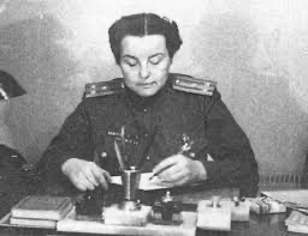
Much information comes out from her own book from 1991 Now I can Tell the Truth. In Gordievsky’s book of 1997 (together with Inna Rogatchi) much material is found about the NKVD/KGB in Sweden which reveals that Zoya Voskresenskaya-Rybkina, who was in Stockholm as NKVD representative with her husband Boris Yartsev, gave NKVD the tip that Raoul Wallenberg should be recruited for NKVD and sent to Stockholm because she had created a close contact with Marcus Wallenberg (senior). However in that “game” the young Raoul Wallenberg was the card that didn’t play the game – Marcus Wallenberg and Raoul Wallenberg were too distant from each other – and therefore Raoul was eventually poisoned in Moscow in 1947 because he did not want to cooperate with NKVD. This was the usual fate that waited failed NKVD/KGB-recruitments. Because of his refusal to become a NKVD agent in his own land he was doomed by Stalin (and Molotov) to die.
On pages 116-122 of ”A Blind Mirror”(Sokea peili) Gordievsky explains his conversations with Zoya during winter evenings in Moscow in 1980. Gordievsky had a meeting with Zoya Rybkina 1980 after she only was the author of childrens’ fairy tales and used the name Vosenskaya. She is also known perhaps for the Swedish SÄPO as Aleksandra Rybkina who arrived in Stockholm in 1941. Gordievsky says:
1. ”Zoya was an exotic beauty whose sensual attractiveness was used by NKVD for strategic operations” (p.117)
2. ”Let us take as an example, Zoya’s achievements in handling Marcus Wallenberg in a remote hotel in Saltsjöbaden during wonderful weekends. These weekends led to a favorable trade deal between the Soviet union and Finland which contributed favorable to the capital of Wallenberg”(p.117).
3. ”First of all she was hard and skillful and was promoted to run in the rank of colonel the department of Austria and Germany after the end of war”(p 118).
4.”Zoya was former case officer of Hella Wuolijoki. After 50 years she told Gordievsky that she considered Hella a reliable spy but her husband Boris Yartsev did not. Today (1980) I can say that I was right (says Gordievsky in his book)… In Stockholm Zoya approached with the help of the Wuolijoki family Niels Bohr (nuclear researcher) in order to get information about nuclear matters…it is a well know secret in the KGB that Zoya Rybkina had a collusion against madam Kollontai, the ambassador of the Soviet Union in Stockholm 1930-1945, who lost her career 1946 as a result of Zoya’s operations. It is also believed that Zoya was able to destroy Kollontai’s diaries 1946”. (p.118)
5. ”It is also a well kept secret inside the KGB that Zoya’s activities in Sweden and closeness to Marcus Wallenberg made her the ”bad spirit” for Raoul Wallenberg and that she informed NKVD about Raoul Wallenberg’s activities in Budapest and possible connections to the United States Intelligence Agency OSS (Office of Strategic Services), an organization that was established in 1942 during the War and preceded CIA, which was established in 1947. And NOTA BENE she managed to get Stalin to approve the operation to capture Raoul Wallenberg with the aim to recruit him for NKVD. The KGB sources refer to this operation as a reason to promote Zoya after the war” (p.119). As is clear from what Sudoplatov writes in his book Special Tasks Stalin was really convinced that Raoul Wallenberg was an agent for OSS and acted accordingly (see below).
As to the reliability of the KGB-MI6 Double Agent Oleg Gordievsky – who himself as a Double Agent MI6-KGB during the NATO exercise Able Archer 1983 with the NATO nuclear forces prevented the outbreak of a real “Nuclear War” between USA/NATO and the Soviet Union – has not been labeled as a liar or somebody who would have lied all this. In his book of 1997 he says that the Swedish government has preferred to have good relations with Moscow/KGB and not to make problems by reveal “too much”.
On page 337 Gordievsky states that he has explained all related to the Wallenberg case in the course of the years to the Swedish official authorities many times. The question may then be put: When and how has the KGB Colonel Gordievsky been talking to the Swedish authorities
about the Wallenberg case? Probably such talks could have occurred in connection with the debriefings held by the Swedish SÄPO after his escape 1985 to the UK. Gordievsky states that the only thing he would like to get as a compensation for his first hand information to the Swedes is that his role as an informant would be published. First hand information about KGB-Agents and KGB- Contacts!? Although the Swedes promised to follow his wishes in this regard, nothing has happened! The only thing Gordievsky has not been sure about is the way Raoul Wallenberg was executed. But in 1994 the NKVD-chief Pavel Sudoplatov in his memoirs explained that Raoul Wallenberg was poisoned 1947. Pavel Sudoplatov died in 1995, labeled as an old man who suffered of sclerosis.
In his book Special Tasks Pavel Sudoplatov places the activities of the NKVD-spouses “Zoya and Boris Yartsev” (as they were known in Stockholm) into the prevailing circumstances 1941, i.e. that the so called Winter War between Finland and the Soviet Union had ended with the severe Moscow Peace Treaty of 12 March 1940 (p 265 et seq). Notwithstanding the peace treaty Finland found itself – after the breaking down of the Molotov-Ribbentrop Pact of 23 August 1939 – participating on Nazi-Gemany’s side in Hitler’s Operation Barbarossa, that is to say the German attack on Russia on 22 June 1941, which lasted until Stalingrad 1942-1943. During that period Finland’s government tried to sound out possibilities of a separate peace with Stalin, in which efforts Madame Kollontai, the Soviet ambassador in Stockholm, as well as the Swedish government participated. But not only them, but also Marcus Wallenberg and Zoya Voskresenskaya-Rybkina (se further below).
Sudoplatov begins his chapter 9 with the title Raoul Wallenberg, Lab X and Other Special Tasks in the following way (p 265): “There are unsolved mysteries involving the Wallenberg family of Sweden. The best known is the case of diplomat Raoul Wallenberg, who was arrested by Soviet military counterintelligence, SMERSH, in 1945 in Budapest and, I believe executed secretly in Lubyanka jail in 1947. The Wallenberg family had clandestine contacts with representatives of the Soviet government from the beginning of 1944, and while I was not involved with Raoul Wallenberg, I was aware of his family’s contribution to our making peace with Finland. The pattern of military counterintelligence reports on Raoul Wallenberg and the family’s connection made him a candidate for recruitment. His arrest, interrogation and death in Lubyanka all fit the pattern of a recruitment effort gone bad. Fear that the attempt to recruit him would be exposed if Wallenberg were released led to his elimination as an unwanted witness”.
Sudoplatov continues (p 265-266): “The Wallenberg’s relationship with the Soviet Union started in 1944, when our reszidentura in Stockholm was instructed to look for influential figures in Sweden who might act as intermediaries between the Soviet and Finnish governments to facilitate the signing of a separate peace treaty between Finland and the Soviet Union. Stalin was concerned that Finland, a German ally since 1941, would sign a peace treaty with the Americans that would not guarantee Soviet interests in the Baltic area: the Americans would not allow us to occupy Finland. In fact, we did not need to occupy Finland; we could keep it neutral through our agents of influence in all of the major Finnish political parties. These agents cooperated with us in return for a guarantee of the preservation of a neutral Finnish role in Europe – a bridge between the Communist and capitalist worlds. This is what came to be known as Finlandization in the 1970s and 1980s”.
Sudoplatov explains (p 266): “Rybkin, a tall, well-built man, had a sense of humor and was a good story teller. He and Zoya were popular on the diplomatic circuit, where one of their missions was to watch for German overtures for a separate peace deal with the United States and Britain without Soviet participation. They were also active in clandestine economic operations. In 1942 Rybkin arranged through an agent, the popular Swedish actor and satirist Karl Earhardt (Gerard), a deal to supply the Soviet Union with high-tensile steel for the aviation industry. We desperately needed that steel because our metallurgic plants were seized by the Germans in 1941 and our supplies from Siberia were unreliable. The deal was a gross violation of Swedish neutrality, but the Enskilda Bank, controlled by the Wallenberg family, profited handsomely from the exchange of the steel for Russian platinium”.
Sudoplatov continues (p 266-267): “The Wallenberg family was interested in a peaceful Soviet-Finnish settlement because its capital investment in Finland. Marcus Wallenberg (Raouls uncle; authors notice: not correct) maintained friendly contacts with Karl Earhardt, and the Center suggested that Earhardt should introduce Zoya to Marcus at a cocktail party”.
“Zoya charmed Marcus Wallenberg, and they agreed to meet again at a luxurious hotel owned by the Wallenbergs outside Stockholm at Saltsjöbaden. Zoya spent a weekend with Marcus Wallenberg planning how to bring together Soviet and Finnish diplomats so that the
terms of a separate peace treaty could be discussed. What was important, she said, was that Wallenberg convey to the Finns that the Soviet side would guarantee real neutrality for Finland with a quid pro quo of a limited Soviet military presence in the Finnish Baltic ports in the area of Porkala”. (italics added by this author).
“It took only a week for Marcus Wallenberg to arrange Zoya ́s first meeting in February 1944, with the Finnish ambassador to Stockholm, Juho Kusti Paasikivi, who later became president of Finland. Alexandra Kollontai, the Soviet ambassador to Sweden and our first woman diplomat, joined the talks under instruction from Stalin and Molotov. The consultation continued throughout the summer of 1944, and on September 4 a treaty was concluded. TASS reported that the government of Finland had severed its alliance with Hitler and signed an armistice agreement with the Soviet Union”.
The Finnish Professor Tuomo Polvinen confirms in his biography of President J.K. Paasikivi that Marcus Wallenberg paid a visit to Helsinki in February 1944 which was organized by Zoya Voskresenskaya-Rybkina in order to consult about peace options. Marcus Wallenberg had a lunch with President Risto Ryti and Foreign Minister Henrik Ramsay on 6 February 1944 in Helsinki in the middle of heavy bombings. Before that the ambassador of the Soviet Union in Stockholm Madame Kollontai had had a lunch with Marcus Wallenberg in Stockholm for launching a secret link via him to the Helsinki government about peace negotiations with Moscow. However the real operator of this scenario was Zoya Voskresenskaya-Rybkina who was the person that organized Marcus Wallenberg’s lunch with Ryti in Helsinki 6 February 1944.The two ladies were as said competitors. In 1949 Marcus Wallenberg was awarded the Grand Cross of Finland’s most high ranking order, the Order of the White Rose, by President Paasikivi for his efforts to assist Finland during the Continuation War and the conclusion of the separate Peace Treaty on 4 September 1944.
Sudplatov continues (p 267): “Thus the detention of Raoul Wallenberg in Budapest in 1945 was not accidental. Stalin and Molotov wanted to blackmail the Wallenberg family; they wanted to use its connections for favorable dealings with the West. In 1945 the Soviet leadership was playing with the “Jewish issue”, cynically spreading rumors that an autonomous Jewish republic would be established in the Crimea, not Palestine, in order to mollify our British ally. I received oral instructions from Beria to plant such rumors in the talks I had with the American ambassador Averell Harriman when I met with him in 1945 under the cover name Matveyev. My speculation is that Stalin wanted Wallenberg recruited to assist in raising the international capital that Stalin hoped to attract for postwar economic reconstruction, using the bait of a Jewish homeland”. (italics added by this author).
“(p 267-268) At the time of his arrest by the Red Army in Budapest, Raoul Wallenberg was deeply involved in the evacuation of Jews from Germany and Hungary to Palestine. We knew he had a heroic image among world Jewish leaders. Wallenberg could not have been detained without direct orders from Moscow. If he was arrested accidentally, as might occur during the fierce fighting in Budapest, local SMERSH authorities were bound to report the incident to Moscow. Now it is known that Nikolai Bulganin, then the deputy commissar of defense, signed the order to detain Wallenberg in Hungary in 1945, and passed it on to Abakumov, head of SMERSH”.
“(p 268) After nearly half a century of fruitless investigations by KGB officials and journalists, the file on Wallenberg is now said to have mysteriously vanished. One of my former colleagues, Lieutenant General Aleksandr Belkin, the deputy head of SMERSH, saw the files before they disappeared. He reported that in 1945 all rezidenturas of SMERSH received an orientirovka (briefing) identifying Wallenberg as an established asset of German, American, and British intelligence. The instructions were to continuously report Wallenberg’s movements to Moscow and to assess and study his contacts with German authorities, both national and local”.
“(268) I recall that Wallenberg’s work in Hungary was given a dubious cast by agent reports from Kutuzov, a Russian émigré in Budapest, a relative of Prince Kutuzov, who had been recruited by us in the 1920s. He worked in the Red Cross mission in Budapest and observed Raoul Wallenberg’s movements. Kutuzov reported that Wallenberg was collaborating with German intelligence. In the high-risk business of freeing Jews, it was necessary for Wallenberg to have frequent negotiations with German security officials. Kutuzov’s interpretation was that Wallenberg was playing a double game. Thus Wallenberg had left himself open to forced recruitment as our agent: join us or be exposed as a German agent. This was how the plans must have been formulated to recruit Raoul Wallenberg and through him promote the cooperation of his family with Soviet representatives in Scandinavia”.
“(268-269) Before he was taken to see the Soviet authorities outside Budapest in January 1945, Wallenberg is reported to have said to a friend, “I’am not sure if I’m going as their guest or their prisoner”. Wallenberg was brought to Moscow under guard, but he traveled in a luxury railroad car and was treated as a guest. Kutuzov was brought back to Moscow separately. However, he was released and in 1952 allowed to return to the West. He settled in Ireland, where he died in 1967”.
“(p 269) Pitovranov, deputy minister of security in those years, told me that Wallenberg’s guards provided him with special food from the dining car on the train from Budapest. When he arrived in Moscow, he was kept in the special block of the internal jail reserved for very important persons. He was considered to be a guest, but not allowed on the streets to talk to people as he wished”.
“An effort was made to develop him as an agent, to operate either with his family or with the Swedish government. His interrogators may have bullied him with charges that he was a Gestapo informer or American agent, but that was not the intention from the top. The goal was to recruit him”. (italics added by this author) (A question from this author: Note the formulation .. “… to operate either with his family or with the Swedish government…”. How could Wallenberg have worked with the Swedish government as a NKVD/KGB-Agent? Or for that matter with his family? This formulation raises the dangerous question of possible cooperation between NKVD/KGB and the Swedish government and/or the Wallenberg family during the 2nd World War?!
“(p 269) It is clear from the archive materials that Wallenberg was held in two jails in Moscow, Lefortovo prison and the internal jail of the Lubyanka. KGB veterans remember that after tough interrogations in Lefortovo, Wallenberg was moved to the second block of the internal jail on Lubyanka Street, where VIP’s and foreigners were held who were scheduled for either recruitment or liquidation. Block two of the internal jail gave the appearance of a hotel. The rooms were not cells in the usual sense; they had high ceilings and were equipped with furniture and conveniences. Food was brought there from the NKVD canteen and restaurant, which was far superior to prison fare. During Stalin’s reign this was a dangerous place: the office of the Kommendatura of the NKVD, where all death sentences were carried out, was located in the internal jail”.
The Toxicological Laboratory
“(p 269-270) Behind this building on Varsonofyevsky Lane, and closely linked to the Kommendatura, was the toxicological laboratory. In my time this laboratory was called LAB X in official documents. Its director, Professor Grigori Moiseyevich Maironovsky, was a leading biological scientist who had worked on the impact of lethal gases and the use of poison in combatting malignant tumors. Maironovsky was highly respected in medical circles, but he became a tragic figure”.
“(p 270) In 1937 Maironovsky’s research group at the Institute of Biochemistry was transferred to the jurisdiction of the NKVD. He became chief of the toxicological research group, subordinated directly to the director of the technical warfare department. They worked for the Kommendatura carrying out executions. The research activities of his group had a legal status endorsed by the minister of security, and were governed by him or his deputy. Yet alongside his research work, Maironovsky carried out death sentences on the direct orders of ministers and commissars of security Beria, Yezhov and Merkulov. From 1937 until 1947, Maironovsky and his subordinates were used to carry out death sentences and secret liquidations with their poisons. There were special passes into the premises of the laboratory, and even top-personnel of NKVD had no access or right to enter their building in the
Kommendatura compound”.
“(p 270) Wallenberg was interrogated by officers of military counterintelligence, primarily Lieutenant Colonel Dmitri Koppelyansky in German, who was purged from the security service in 1951 because of his Jewish origin. Although Koppelyansky’s involvement is stated in the documents , he was denied his role in the case, insisting that he does not remember Wallenberg. However, he is listed in the jail’s records as being responsible for interrogating Wallenberg, and he was the officer who called Wallenberg from his cell to his office just one day before his death. Koppelyansky vigorously denies his involvement because he fears to be associated in any way with the Kommendatura and its top-secret cell”.
“By early July 1947 Wallenberg’s case was stalled. Wallenberg had refused to cooperate and he was eliminated, at the same time that the leadership continued to tell the Swedes that they knew nothing of his fate”.
“(p 270-271). My best estimate is that Wallenberg was killed by Maironovsky, who was ordered to inject him with poison under the guise of medical treatment. According to witnesses who told me the story, Wallenberg was kept in the second block of the jail, where medical checkups and injection were routine for prisoners. One of the reasons I believe Wallenberg was poisoned is that his body was cremated without an autopsy, under the direct order of Minister of Security Abakumov. An autopsy would have revealed the exact nature of his death. The regulations were that those executed under special government decisions were cremated without autopsy at the Donskoi cemetery crematorium and their ashes buried in a common grave. The authorities have reluctantly admitted that such prominent figures as Yakir, Tukhachevsky, Uborevich, Meyerhold, and others were dispatched in this manner. Since Donskoi crematorium was the only in Moscow until 1951, it is likely that the ashes of Wallenberg, Yezhov, and Beria are buried in the same common grave”. (italics added by this author).
“(p 271) The record book of all operations undertaken by Maironovsky and his subordinates, which was placed in a sealed envelope marked top secret after the arrest of Beria and sent directly to a special section of the Politburo secretariat, has never been seen again. There is no record of its being removed to another place. There are two witnesses who testified that this top-secret book, in its envelope, was taken from Lubyanka by Malenkov’s chief assistant, Dmitri Sukhanov, who is still alive. I never read the contents, but I saw the envelope, sealed with red wax and marked: “Do Not Open Without the Approval of the Minister”. I understood that this record book contained the names of victims, dates of executions, and names of those who carried out the orders to eliminate unwanted persons by poisonous injection. I believe these records still exist”. (italics added by this author).
“(p 271) Some documents have come to light. In June 1993, Izvestia published an article by journalist Ella Maxsimova titled “Wallenberg Is Dead. Unfortunately, There is Sufficient Proof”. In it new details are revealed. She cites documents confirming Wallenberg’s stay in Lubyanka and Lefortovo prisons and the memorandum to Molotov discussing the fate of Wallenberg. Molotov, as deputy prime minister and head of the Committee of Information, gave the order for Wallenberg’s liquidation. This follows from the letter of Andrei Vyshinsky, who was deputy minister of foreign affairs in this period. What is concealed is that he was also the acting head of the Committee of Information, the coordinating and decision-making body for the intelligence and security agencies”.
“(p272) This highly significant letter from Vyshinsky to Molotov, dated May 14, 1947, registered number 312-B, signed on May 13, 1947, has been declassified from its top-secret classification. There are no titles on the document, clearly indicating it is an internal memorandum:

“(p 272-273) The Izvestia article raises a question of semantics. The last words of Vyshinsky’s letter, lekvderovat delo, can mean both “his liquidation” – that is Wallenberg’s – or “liquidation of this case”. The question the article posed is, could Vyshinsky have meant to finish the case that was going nowhere by releasing Wallenberg, or is the use of the word “liquidation” clear enough that he meant physical extinction of the person? Could there have been a tragic misinterpretation of the order?”
“(p 273) To me it is clear that this was not a suggestion to close the case, but one to eliminate Wallenberg. The term “liquidation” in such top-secret documents meant physical elimination. Wallenberg had become an unwanted witness, which is clearly implied by Vyshinsky”.
“(p 273) The document sent to Stalin and Molotov in 1947 on the fate of Isaac Oggins, an American working for us, contained similar phrasing when Abakumov proposed to eliminate Oggins with no trace of violent death”.
“(p 273) Molotov’s comment on the Wallenberg letter is also significant. It is typed in the left- hand corner: “Comrade Abakumov: Report to me. Molotov May 18, 1947”.
“(p 273) This comment was an order to Abakumov to submit a proposal on how Wallenberg was to be liquidated. This was the usual procedure. After that proposal was made and considered, Stalin or Molotov, would give oral approval, and Abakumov, the minister, would note in his own handwriting on the proposal “Consent given by Comrade Stalin” – or, in this case, “by Comrade Molotov”.
“(p 273) Wallenberg died on July 17, 1947, according to official Soviet documents, but it was not until one month later, on August 18, 1947, that Vyshinsky informed the Swedish ambassador in Moscow that the Soviet government had no information on Wallenberg’s fate and that there was no way he could have been detained by Soviet authorities; he had probably perished in Budapest”. (italics added by this author). Please compare here the statement of Suduplatov with what I say in my text above: Finally, in August 1947, the Soviet Deputy Foreign Minister Andrey Vyshinsky declared in an official note that Wallenberg was unknown to Soviet authorities and that he was not found ”on the territory of the Soviet Union”. This
was of course a lie, which the Soviet Foreign Minister Andrey Gromyko conceded in a message to the Swedish government ten years later. In February 1957, Gromyko announced that Wallenberg had been held in Soviet prisons for more than two years. However, according to a note signed by Dr. A.L. Smoltsov, head of Lubyanka Prison’s medical service – Wallenberg died suddenly in his cell on July 17, 1947).
Let ́s continue with the quotations from Sudoplatov, who has firsthand knowledge of the circumstances around Wallenberg’s death: “(p 273-274) Also in June 1993 Izvestia for the first time published in full the memorandum from the Soviet government to the Swedish government on the fate of Wallenberg. The draft was compiled by the Ministry of Foreign Affairs and the KGB on January 12, 1957. At that time Dmitri Trofimovitj Shepilov was the foreign minister and Ivan Aleksandrovitj Serov was head of the KGB. The text:
“(273-274) In accordance with the decision of the Central Committee of the CPSU on May
3, 1956, the Ministry of Foreign Affairs and the KGB submit the draft of the answer to the government of Sweden on the question of the Swedish diplomat Wallenberg . The draft of
the decision is attached. (signed) Shepilov and Serov.
“(p 274) Draft aide-memoire (p 274)
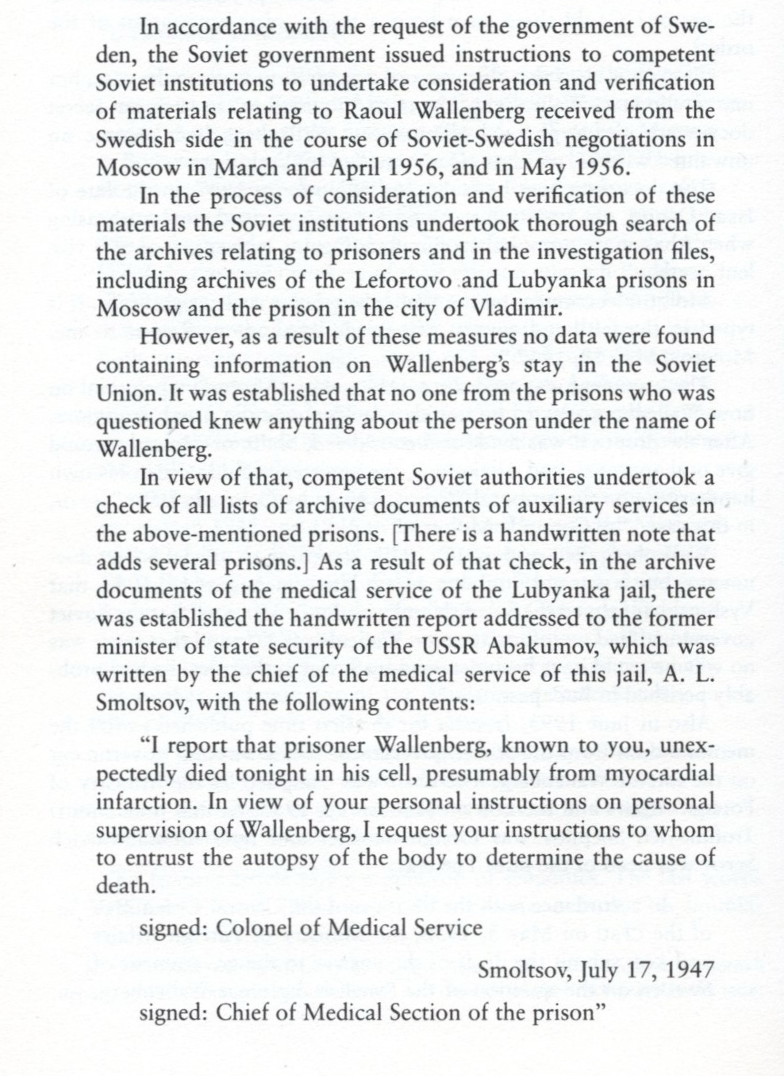
“(p 275) On this report is a handwritten notation by Shepilov: “Reported personally to Minister (Abakumov). The order: cremate the body without an autopsy. July 17, 1947”…
The Soviet government sincerely expresses its sorrow on this occurrence and expresses its deep condolences to the government of Sweden and the relatives of Raoul Wallenberg.
“(p 275) Still missing is the mysterious decision of May 3, 1956, on the Wallenberg case by the Central Committee of the CPSU to undertake verification of the case. I believe that at this time they were beginning to destroy documents, because Bulganin and Molotov were still in power and the case directly involved Bulganin, who has his name on the arrest order for Wallenberg”.
“(p 275) It was not until February 1957 that the death of Wallenberg in 1947 of a heart attack was officially announced by the Deputy Foreign Minister Andrei Gromyko. At that time, Bulganin, who had ordered Wallenberg’s arrest in 1945, was the prime minister. Gromyko could not announce the death of Wallenberg without the consent of the Politburo. Thus, there should be a record of the Politburo decision in several files. From my knowledge , File 6 in the KGB archives should contain a secret summary reporting the main facts of Wallenberg’s stay in Soviet jails”.
“(p 275) Krushchev and his subordinated announced that Raoul Wallenberg was arrested unlawfully by Minister of State Security Abakumov, a criminal, and that he died in detention due to heart failure. Abakumov had been executed for committing this crime, among others, they said. This was a cynical lie, because Abakumov was never accused of detaining Wallenberg. That is clear from Abakumov’s indictment, which was recently published in
Moscow. Far more interesting is the absence of the report by KGB head Serov to Kruschhev on what really happened to Wallenberg, the secret summary that would have been written before Gromyko’s statement could be approved by the Politburo”.
“(p 275-276) The last order to investigate the Wallenberg case was given by President Gorbachev to KGB chief Bakatin in August 1991. The investigation revealed that Wallenberg died in prison and that his file was missing. This investigation was supervised by Professor Vyacheslav Nikonov, the chief of the Bakatin’s secretariat and grandson of Foreign Minister Molotov. Somewhere in the Ministry of Security there must be a letter from Abakumov to Molotov discussing Wallenberg’s detention by the organs of state security. Although the copy of this letter is missing from the KGB archives, it should be recorded with a code number in the book that registers all KGB letters to the government signed by a minister. Therefore the letter can easily be traced in the Molotov’s section of the Presidential Archives. The next investigator must look for the letters from Abakumov to Stalin and Molotov that are registered in File 6 of the Central Operation Archives of the KGB. Once the date is established the search should not be difficult”.
“(p 276) Ivan Serov, chairman of the KGB in 1957, would have written to Krushchev, requesting permission to destroy the Wallenberg file. The reason for destroying the file is evident: in February 1957 Molotov was still an authoritative and powerful figure in the Soviet establishment, one of the leaders who naturally wanted to destroy evidence of their involvement in scandalous international incidents in the 1930s and 1940s. Serov’s letter should be traceable in the Krushchev section of the Presidential Archives, which I believe were inviolable”.
(Ivan Serov was the Chief of KGB 1954-1958 and Chief of GRU 1958-1963. Serov’s diaries were found in a garage at a datja during summer 2016 and were published 2016 with the title Notes from a Suitcase, see extracts and comments further below).
“(p 276) Sudoplatov continues: “Krushchev certainly would have done that favor for Molotov; he must have ordered Serov to destroy Wallenberg’s file in the KGB archives, but it is likely he kept that letter from Serov to incriminate Molotov later. I remember after my arrest, how vaguely but persistently my interrogators asked me what I knew about Molotov’s involvement in secret deals with various prominent Western industrialists and diplomats. At that time I had no idea that these questions were not accidental”.
“(p 276) It is possible that a curious researcher will find a second letter from Serov to Krushchev, in which he must have reported the destruction of KGB files explaining the liquidation of Wallenberg. Even the tightest cover-up cannot anticipate accidents. In April 1992 Wallenberg’s diplomatic passport and other personal belongings were accidentally found by a KGB archivist technician who had nothing to do with attempts to reinvestigate the case. They were in an envelope that fell from a huge bundle of unsorted documents in a room that was formerly the main block of the NKVD Lubyanka jail.
“(p 276 note 11) When Krushchev visited Sweden in June 1964, Prime Minister Tage Erlander asked him for specific details about the fate of Wallenberg. Krushchev blew up and said the Soviet government had given a full reply in 1957. “Do you think we are liars? I will return home immediately”. Krushchev threatened. The Swedish government backed off the search for Wallenberg”.
“(p 276-277) The cover-up of Wallenberg’s case is similar to efforts to hide the infamous Katyn affair. Aleksandr N Shelepin, then chairman of the KGB, in 1959 approached Krushchev for permission to destroy all documentary evidence in the KGB archives that recorded direct instructions to eliminate Polish officers prisoners of war at Katyn, near Smolensk. The revelation of Shelepin’s request shows how the records have been pillaged. That such sensitive documents in the KGB archives were destroyed makes me believe that a similar trick was played with the Wallenberg file. However, it would be difficult even for a determined paper shredder to get rid of copies in all the repositories, especially Presidential Archives”.
“(277) Shelepin’s report about the destruction of files of the 21 857 Polish officers executed at Katyn and other camps in 1940 was revealed from the top-secret archives only in October 1992, together with Beria’s letter to Stalin recommending that Polish officers be executed. Now documents on Katyn have surfaced from the archives, but they are being released selectively”. END OF QUOTATIONS FROM SUDOPLATOV
I have chosen to include extensive full-text-quotations from Sudoplatov’s book Special Tasks, that appeared in 1994, since Suduplatov not only is supporting the books and statements of the NKVD/KGB-officials Zoya Voskresenskaya-Rybkina and Oleg Gordievsky’s “A blind mirror”, which all are more or less presenting “the same story”. These books and messages have, however, emerged under different circumstances, which must be taken into consideration when judging if it is a “true description of the events or not”.
The KGB-MI6 double agent Gordievsky defected to the West in 1985 and have thereafter, by his revelations to Western intelligence agencies, more or less destroyed the “then existing KGB-net”. So, why should he “lie up a story”? And for the “beauty” of Zoya Voskresenskaya-Rybkina why shouldn’t Marcus Wallenberg senior have had an affair with her? After all so called “honey traps” were the real specialties of NKVD/KGB (as for nowadays FSB, SVR). And Stalin’s and Beria’s “own executioner” Sudoplatov published his Special Tasks in 1994 after having served fifteen years in Soviet prisons. Would he invent the story of Wallenberg? He was himself an actor and a personal witness to all cruelties ordered by Stalin and his henchmen. He was nearly to be executed together with Beria in 1953. Above all Sudoplatov knew about all the rules and routines for the prisons, the prisoners and the political apparatus. He is also able to reconstruct documents as well as locate missing documents. In his Special Tasks he takes even upon himself “to guide future researcher” in the Wallenberg case. Do that! Search here! Search there!
Taken all this together it seems that kind of a “true story” about the fate of Raoul Wallenberg is emerging from the stories that hitherto are told, the contents of which are the following : The Wallenberg family was blackmailed by NKVD/KGB for the purpose of pressing money and political advantages for the Soviet Union out of the cooperation with them and their distant relative Raoul Wallenberg, whom NKVD/KGB tried to force to become a NKVD/KGB-agent in Sweden. Honorably enough he refused “the offer” and for that he was on Stalin’s and Molotov’s orders liquidated by poison on 17 July 1947, in accordance with the routine developed for “recruits that went bad”.
As was mentioned above Ivan Serov was the Chief of KGB 1954-1958 and Chief of GRU 1958-1963. Serov’s diaries were found in a garage at a datja during summer 2016 and were published 2016 with the title Notes from a Suitcase. Let us see what Serov writes in his diaries:
Vadim Birstein: The Wallenberg Chapter: Serov’s Original Typed Manuscript Translated:
Page 1
The Wallenberg Case
In 1987, various journalists, Soviet and foreign, began calling me at my dacha [country house]. All of them were interested in one person, Wallenberg.
I (Serov) did not want to talk about this topic, and I answered/told all of them the same thing: “I don’t know anything about this case.” I wondered where they found my phone [number], which was not listed in any directories. However, my son-in-law had many journalist friends who possessed this number.[1] I even asked that my number be changed, and that was done.
All these telephone calls and persistent requests of journalists convinced me to recall what I knew of the Wallenberg case.
For the first time, I heard this name in 1942, when I worked as Plenipotentiary of the Stavka [Main Command of the USSR Armed Forces during World War II]. Then I knew that a relative of the prominent Swedish bankers, Wallenberg, had arrived in the temporarily occupied territory, specifically in [the city of] Pskov, where he had contacts with the Fascist [Nazi] civil administration and the “Abwehr.”[2]
Many years passed by. This name I have forgotten, but I was forced to recall it by the head of counter- intelligence, the old employee of the organs [secret services] [Pyotr] Fedotov.[3] In 1954 (or at the end of 1953, now I don’t remember exactly), Fedotov reported to me that the Swedish government circles were actively interested in the Wallenberg case. “Report in detail what he did,” – I said.
“He was a representative of the Swedish Red Cross in Budapest, [he was] closely associated with the German and American agents, – said Fedotov. – In 1947, he was liquidated on Abakumov’s order.”[4]
Fedotov said that the interest in Wallenberg was caused by the fact that many former prisoners of war and internees, and previously detained foreign nationals were returning to their Motherland.[5]
“Keep this case under control,” – I ordered Fedotov.
After some time, Fedotov reported to me that, in addition to Wallenberg’s registration card kept in [military] counterintelligence, the main operational materials were in the Second European Department of the Committee of Information [KI].[6] Apparently, when Fedotov worked as Deputy Chairman of the KI, he saw these papers.
Then I invited [Vasily] Dobrokhotov, who a few days earlier had been transferred from the Secretariat to Foreign Intelligence, and ordered [him] to collect everything that at the moment was available on Wallenberg.[7]
Page 2
N.S. Khrushchev called me, and the Wallenberg case became one of the points of our conversation. N. S. Khrushchev was very interested in this case because he had no knowledge of it, and instructed [me] to find out why the West was so interested in Wallenberg.[8]
Khrushchev forbade me to tell Molotov and the MID [Foreign Affairs Ministry] the circumstances of this task given to me. From conversations with him, I had the impression that he wanted to blame Beria and Abakumov as fully responsible for the liquidation of Wallenberg, and this would help improve relations with Sweden, building bridges with the Swedish government and the financial community, and, possibly, engage them as intermediaries in establishing relations with the West, to which Khrushchev was very keen. Also, Khrushchev had, obviously, and other reasons, but I’ll describe them later.
In the meantime, we collected the material. Some time before that, [our] counterintelligence found out that during his visit to the USSR, a Swedish Social Democrat, a Jew by nationality, met with Ilya Ehrenburg, who was in the MGB operational cultivation.[9] (Even in 1949, Abakumov raised the question of his arrest, but Stalin did not give his sanction [for that].)[10]
This Social Democrats had given the task to Swedish intelligence to reach Voroshilov (at the time, he was Chairman of the Presidium of the [USSR] Supreme Council, but in the West he was called the USSR President) through any prominent public figure. As a channel, Ehrenburg was chosen, taking into account that he was [well] known abroad and given his Jewish origin.
In 1954, during a meeting in Moscow with Ehrenburg, this Swede asked him to organize a meeting with Voroshilov. After that, Ehrenburg met with [Fyodor] Kharitonov, head of the 4th [KGB] Department, but the latter recommend avoiding concrete answers.[11]
Now a few words about the essence of the Wallenberg case. Dobrokhotov reported to me that the information about the special mission of Raoul Wallenberg in the territories occupied by the Germans, was originally received from Sweden and the USA.
American materials had special meaning for us. From our sources in US intelligence during the war, one of its prominent staff reported that Wallenberg, as a US intelligence agent, had established communication with German secret servicemen.[12]
Under the guise of negotiations on the fate of Jews in the occupied territories, there was an informal channel of regular communication between the Hitlerite and American intelligence services.
Page 3
Wallenberg was detained by SMERSH in early 1945, immediately after the liberation of Budapest. [13]Slovak diplomats were arrested together with him.[14]
Originally a transfer of Wallenberg to the Swedish side was planned. However, after an operational document [orientirovka] about his links with the Hitlerite secret services and American intelligence came from the [NKGB] First Directorate (intelligence), Stalin ordered Abakumov to arrest Wallenberg and sent him to Moscow.[15] His driver, at the moment I do not remember his name, was sent to Moscow together with him.
The documents taken from Wallenberg indicated that he had regular contacts with high-ranking Nazis, including the infamous Eichmann, the organizer of the mass liquidations of the Jewish population. [16]There were also credible data that the Swedish Embassy in Budapest was issuing diplomatic passports and other documents for the Hitlerite security service men for their cover.
Wallenberg was suspected of being involved in this activity, since [he] repeatedly traveled to the occupied territory, including, as I have already pointed out, to [the city of] Pskov. He was charged as a Nazi spy.
Dobrokhotov inspected the materials of the Committee of Information and of the [MGB] Investigation Department for Especially Important Cases and found out that at first Wallenberg was listed under SMERSH [military counterintelligence], but then, after deputy head of the Investigation Department, Likhachev (later executed).[17]
Colonel Kozyrev from the KGB Investigation Department reported to me that no operational material was used during the investigation of the Wallenberg case. There was also no direct evidence incriminating him of spying. At the same time, Wallenberg did not deny himself that he was in constant communication with a number of prominent Nazis and American intelligence men known to the MGB.
From [Vasily] Dobrokhotov and [Pyotr] Fedotov’s reports it was clear that Stalin and Molotov planned to use Wallenberg’s testimonies for secret negotiations with the Americans about which matters should not be discussed at the Nuremberg Process [the Soviets participated in the International Military Tribunal only – V. B.].
Fedotov, who, as I think, was a member of the Commission on preparation of the [Nuremberg] Process, told me that the Americans made advances to us by agreeing to omit discussions of the secret protocols of the 1939 Molotov-Ribbentrop Pact in exchange for us not raising the question of financial connections of the USA with Hitler’s industrialists with the Wallenberg family as a mediator, and their separate peace negotiations.[18]
Page 4
After the end of Nuremberg Process Raoul Wallenberg lost his value. Stalin thought that returning him back home made no sense, and it seems Molotov raised the question of his liquidation, as well as a number of the other American, German, and Japanese diplomats arrested by us after the war.[19]
The circumstances of Wallenberg’s liquidation could not be established decisively. The documents kept in the file, a report of the prison doctor about the death and the certificate [akt] of cremation, signed by the warden of Internal Prison [Aleksandr] Mironov and MGB Commandant [in fact, Chief Executioner] Blokhin demonstrated only the fact of Wallenberg’s death in 1947.[20]
When interrogated on the Wallenberg case, Blokhin stated that his staff had nothing to do with the Wallenberg liquidation, or, at any rate, he did not remember about that.[21]
When interrogated, Mairanovsky and workers of his special laboratory chamber [kamera] [i.e. the laboratory where poisons were tested on prisoners] confirmed that in 1946-1947 they liquidated a number of foreign nationals who were kept in Inner Lubyanka and Vladimir MGB prisons.[22] They also did not remember any specific names.
Abakumov, interogated by [Aleksandr] Kozyrev, confirmed the liquidation of namely R. Wallenberg.[23] He referred to the direct orders of Stalin and Molotov, who he repeatedly informed in detail about the case. It was also found out that Bulganin, Deputy Commissar of Defense and a member of the GKO [State Defense Committee], gave a direct order to arrest Wallenberg in 1945.
All this I reported in detail to Khrushchev. He carefully listened to me and said: “These scoundrels, Stalin, Molotov, and Vyshinsky, brewed this rotten mess, and we now slurp shit.”
He asked me a few more clarifying questions about the participation of Molotov and Vyshinsky in this case and told me “not to blame Abakumov and his cronies for this specific episode with Wallenberg.”
At the same time, Khrushchev ordered me to talk to Molotov [and ask him] why the West once again recalled the Wallenberg case.
I met with Molotov in his office. When I asked, his reaction was extremely painful, he said that only an idiot can hope “to get some benefit from this case,” that this case can’t serve as a pretext for establishing informal relations with the Swedish financial and industrial circles.[24] He stated that he wasn’t going to return to this subject any more.
And at the end of the conversation Molotov suspiciously asked me: “And why are you raising this case now?” I answered him that I’m carrying out the instructions of the Central Committee of the Party.
Page 5
I retold the content of the conversation [with Molotov] to N. S. Khrushchev, and he got angry and said that it is still necessary to get rid of Molotov. Khrushchev ordered me to continue the secret investigation through intelligence channels. At the same time, he forbade me to send any documents to the Central Committee on this topic.
I think his attitude was connected with the fact that until 1954, the whole Special Sector [i.e., Secretariat] of the Central Committee’s Presidium [former Politburo] was controlled by [Georgy] Malenkov and his assistant [Dmitry] Sukhanov, who Khrushchev did not trust.[25]
Then Khrushchev still needed Molotov for dealing with Malenkov. (As a result, in January 1955,
Malenkov, with Molotov’s help, was removed from the post of the USSR Council of Ministers Chairman).[26]
After the removal of Malenkov, the Molotov’s turn came. I think that N. S. Khrushchev decided for himself to immediately use the Wallenberg case against Molotov and to begin with, remove him from the MID.[27]
Molotov understood this perfectly, since he treated me as Khrushchev’s man (during the Presidium of the Central Committee [CC] [meeting] in 1954, he, together with Malenkov did not support my appointment as KGB Chairman; in connection with the division of the MVD [Interior Ministry] into two organizations, Malenkov wanted to appoint [Nikolai] Shatalin, CC Secretary, as KGB Chairman).[28]
Returning to this subject, I note that, in general, the question of the KGB creation, as of an independent agency, surfaced unexpectedly. At a Presidium [meeting] [MVD Minister Sergei] Kruglov raised a question about the new MVD structure, but a few days before that Khrushchev entrusted me in secret form to prepare for him a note on the establishing the KGB.[29] This happened a few days after the celebration of the 300th anniversary of the reunification of Ukraine and Russia.[30]
I ordered head of the Secretariat Dobrokhotov to prepare this material [apparently, a plan of the KGB organization] and, without signing, handed it over to Khrushchev’s assistant [Grigory] Shuisky.[31]
The work on the Wallenberg case continued. According to my instructions, in 1955 Kharitonov once again met with Ehrenburg and suggested that at the next meeting with the representatives of Sweden he would hint that he did not exclude the possibility that Wallenberg was imprisoned in the Soviet Union, and, possibly, fell victim to the criminals Beria and Abakumov.
I ordered [Aleksandr] Panyushkin to clarify the Swedish response to Ehrenburg’s words.[32] This reaction soon followed–the representatives of the Swedish MID directly hinted to our Ambassador [Konstantin] Rodionov that their government was not accusing the current USSR leadership of the involvement in the Wallenberg case, that it was a result of Beria’s crimes.[33]
Page 6
However, I understood that it was necessary to use more than one channel (Ehrenburg), but several. For these purposes, an information leakage should be organized through the agency of
our rezidenturas in various countries for informing the Swedish authorities about the readiness of the USSR to discuss the questions of Wallenberg’s fate.
This should be done not only in Finland, where our operational capabilities were always strong, but in some other country. Panyushkin suggested to use our rezidentura in Turkey, which had a
connection with an eminent Finnish diplomat, known for his broad and informal contacts in the Swedish MID.[34]
In conversations with me Khrushchev several times returned to the Wallenberg case. I realized that this case was extremely important for him, that he wanted to use this case, like a number of others, in order to get rid of some of the Presidium of the Central Committee members, who were dangerous for him.[35]
I think that if it were not so, no one would have remembered the Raoul Wallenberg case at such a high level.[36]
I was involved in the preparation of documents for responses to the [diplomatic] notes of the Swedish government. Our position on the question of Wallenberg was always coordinated with N. S. Khrushchev because of the forthcoming visit of the Swedish Prime Minister [Tage] Erlander to Moscow, which the party leadership of the country gave great importance. This visit took place in 1956, but no documents were handed over to the Swedes.[37]
N.S. Khrushchev ordered me and Molotov not to hurry with the answers until after the parliamentary elections in Sweden.[38]
Time passed by. A Central Committee plenum took place, at which N. S. Khrushchev punished the anti-Party group, and then I finally understood why he asked me to pick up documents on this dirty case.[39]
After I retired, I had an informal conversation with a prominent statesman (I promised to never say his name).[40]
He asked me: “Ivan Aleksandrovich, is it possible that Wallenberg is in prison today under a false name?” I told him that my staff had a very thorough review [of the case] and I have no doubt that Wallenberg was liquidated in 1947.
(for the notes pertaining to Birstein’s article turn to http://www.vbirstein.com/the-wallenberg- chapter-the-original-typed-manuscript-translated/ )
Molotov, born in 1890 under the name of Skryabin, was dismissed as Foreign Minister in 1956 by Krushchev and succeeded by Dmitri Shepilov. Molotov was removed from all political positions in 1961 but died as late as 1986, 96 years old. To the contrary of “the old times” he was not liquidated.
Thus, adding also KGB/GRU Chief Ivan Serov’s “diary-information” (which came to surface only 2016) to the testimonies of the KGB-MI6 double agent Gordievsky, the NKVD-agent
Zoya Voskresenskaya-Rybkina and the NKVD Chief Sudoplatov it is clear that Raoul Wallenberg deliberately was murdered/poisoned on order from Stalin and Molotov on 17 July 1947 and that consequently the Soviet leaders were lying to the Swedes from the very beginning of the Wallenberg case 1945. Even if Raoul Wallenberg died on 17 July 1947 it was first one month later, 18 August 1947, that the Deputy Foreign Minister Vyshinsky informed the Swedish ambassador in Moscow that the Soviet government had no information on Wallenberg’s fate and that there was no way he could have been detained by Soviet authorities and that he probably had perished in Budapest. And still he was ordered by Stalin and Foreign Minister Molotov, Vyshinsky’s own boss, to be murdered in the jail in Moscow.
The Russians were still lying to the Social Democrat emissary Hjalmar Mehr when he met with Ilya Ehrenburg in Moscow in 1954, asking for a meeting with president Voroshilov (see Serov’s notes above). Further information about Swedish-Soviet contacts is given in the Report 2000 by the Swedish – Russian Working Group, a basic and important document summarizing the situation of the Wallenberg case twenty years ago (see Enclosure 1 and text below).
It should be mentioned that Suduplatov’s book from 1994 Special Tasks is known to the Working Groups, which however do not, according to this Author, take its content and its messages into full consideration. After all, what else information could they ask for? Considering the total chaos that prevailed during the 2nd World War and Stalin’s planned occupation of Eastern Europe (against all principles at Yalta). The “Iron Curtain” was about to go down.
Sudoplatov is, with his absolute unique position near Stalin, Beria and Molotov, one of the most important sources regarding Wallenberg. Perhaps the complementary information given by Gordievsky, Zoya Voskresenskaya-Rybkina and Serov, appearing quite late, is necessary to be able to fully estimate the content of Sudoplatov’s book. Something that has been more or less totally disregarded in earlier writings about The Wallenbergs and their distant relative Raoul Wallenberg are the elements of “blackmail, charm and passion” that so clearly appear in Gordievsky’s and Zoya Voskresenskaya-Rybkina’s but also in Sudoplatov’s books and information. Marcus Wallenberg (senior) had put himself in a very sensitive position in relation to the Soviet Union, Stalin and NKVD/KGB, a position that somehow must be concealed and hidden from outside scrutiny. But NKVD/KGB knew! They never forget.
Not to talk about NKVD/KGB revenge, pressure and blackmail for “things that went wrong or not fully complied with”. One such result was the death of Raoul Wallenberg 1947. Within this unfortunate framework must be mentioned that the son of Marcus Wallenberg (senior) Marc Wallenberg, the main heir to the Banking group Skandinaviska Enskilda Banken that was to be formed 1972, on 18 November 1971 was found dead in a forest outside Stockholm. The death was said to be suicide by shooting. The other son of Marcus Wallenberg (senior), Peter Wallenberg (1926-2015) was 1993 involved in a serious threat of kidnapping and blackmail from a group of Russians (spetznaz?).
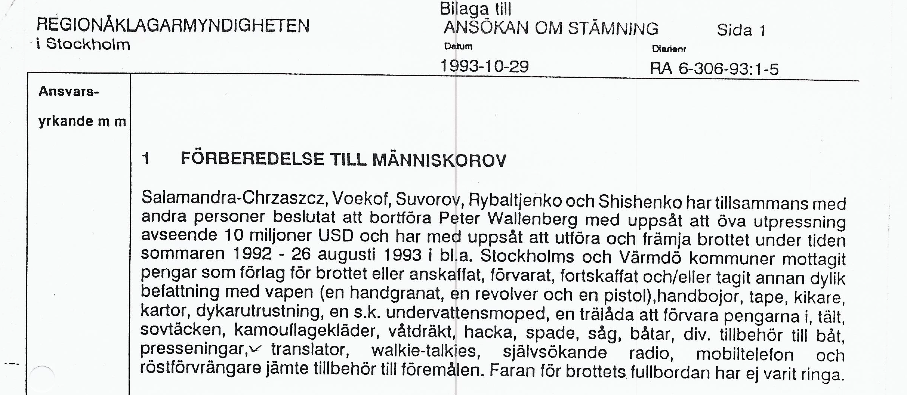
The Russians lied to Prime Minister Tage Erlander at his first visit to Moscow in 1956 (see my text above). It is first with Deputy Foreign Minister Gromyko’s message to Sweden in 1957 that the Soviets admit that Wallenberg was taken into custody in 1945 and that he died from heart failure in 1947. When Krushchev visited Sweden in June 1964, Prime Minister Tage Erlander asked him for specific details about the fate of Wallenberg. Krushchev blew up and said the Soviet government had given a full reply in 1957. “Do you think we are liars? I will return home immediately”. Krushchev threatened. The Swedish government backed off the search for Wallenberg”. (Sudoplatov p 276 note 11). Of course Krushchev was lying. Krushchev was deposed by Leonid Breshnev on 14 October 1964.
In the summing up of all wrong-doings that were made on both sides in the Wallenberg-case, the paramount factor is actually the Swedish envoy Staffan Söderblom’s almost “insane message” to A N Abramov, Head of Section at the Soviet Foreign Ministry MID, on 26 December 1945 “that Wallenberg was dead by accident or robbery”. Which message Söderblom repeated to Stalin himself in the unique audience in the Kremlin on 15 June 1946 (see above). This “peculiar message”, coming from the Swedish side itself, must have been “very liked” by the Russians, since it perfectly well coincided with their own views and wishes how to finally end this disturbing affair.
Söderblom’s message to Stalin in June 1946 must have paved the way for Stalin’s decision to get rid of Wallenberg (since the Swedes didn’t care about him). But as we can see for ourselves from the detailed text of Sudoplatov, Wallenberg was in December 1945 as well as in June 1946 sitting in his cell in the Lybyanka-Lefortovo prison, some blocks from MID and the Kremlin, where the Swedish envoy Söderblom was received by Stalin. The truth is that on these very dates Stalin as well as Molotov are sitting contemplating to liquidate Wallenberg – partly because of the espionage they meant he had performed in Budapest against Soviet interests partly because he stubbornly had refused to become an agent for NKVD/KGB.
It was also within the power of the Swedish Foreign Minister Undén to have saved Wallenberg’s life if he – as I have referred to above – would have uttered a single word about Raoul Wallenberg when he met Foreign minister Molotov at the U N in New York 21 November 1946. Undén was at that time, as indicated very clearly, in a position to give the Soviets what they wanted in terms of generous economic credits. The Soviets might very well have complied with wishes from the Swedish Foreign Minister, especially taking into account their desperate need for money and credits. But no words came over Undén’s lips regarding Wallenberg and thereby Wallenberg was doomed to be liquidated. Only eight months after the meeting in New York Wallenberg was executed. What a formidable mistake and naivety and lack of political insight into what scoundrels the Soviet leader really were that characterized the Swedish Foreign Minister Undén in New York when seeing Molotov.
In summary, I would also like to say that the possibility cannot be discounted that the Raoul Wallenberg case all along was guided and handled through illegal penetration agents – and so- called ”agents of influence” – in the Swedish Foreign Ministry and the Swedish government itself. This is of course a most sensitive, delicate and even dangerous thing to expand upon, but I am afraid it is necessary to do so. From my military background (in liaison with the Intelligence service) I was able to study these matters more deeply than most others. Nevertheless, I am shocked at what I have found. I am deeply disturbed that I have to write down such suspicions and allegations, but I am forced to do it. History demands correctness and no deviations from the truth. Here, I refer to my four volumes of Dagbok från UD (Diaries from the Foreign Ministry). In my concluding remarks I must repeat what I said earlier in my text:
Namely that it was a great risk for sensitive documents to get into the hands of persons who should not have access to them. I can of course here refer to Colonel Stig Wennerström, who worked in the Foreign Ministry. This is where he copied some of the highly secret documents that he handed over to Soviet intelligence (GRU/KGB). He was sentenced to life imprisonment in 1964. There were also persistent rumors that Wennerström had assistance high up in the leadership of the Foreign Ministry, a person referred to as “Getingen” (“the Wasp”). Therefore extreme care had to be exercised in the handling of top secret documents, to which category the Wallenberg papers belonged. One never knows what kind of damage a person like “Getingen” could have done in the Wallenberg case. If “Getingen” indeed existed and was operating in the Foreign Ministry, as he was, he could very well have helped to prepare the way in favor of the most optimal solution for the Soviet Union, that is to say to place roadblocks in the path of the official investigation. But wasn’t that, in fact, actually the outcome of the whole Wallenberg case? Now Wallenberg is officially proclaimed dead. The Soviet Union/Russia has in the long run escaped the shame it would have faced if the full and awful truth of his treatment had been revealed.
To conclude, I would like to add some personal thoughts and comments. As I mentioned earlier, I have direct personal experiences dealing and negotiating with the Soviet Union, most notably during the 1980s, when I served as the chief negotiator in discussions about the delimitation between the Swedish and the Soviet Economic zone east of Gotland, the so called “White Zone Area”.
After some very difficult years of secret talks, meetings and negotiations in Moscow and at other capitals during the period 1984-1985, I and my Soviet counterpart agreed on specific percentages for the delineation of the so called “White Zone” area east of Gotland, in the middle of the Baltic sea. The matter had developed into serious subject of confrontation, with perpetual incidents involving Swedish and Soviet fishing boats and naval vessels. The outcome was extremely favorable to Sweden, which I reported to the Social Democratic government in February 1987.
Owing to the very strange Swedish habit of destroying everything good that happens, a serious quarrel broke out within the government and the Foreign Ministry how to manage this success. As always regarding the Swedish relations with the Soviet Union, the government was almost paralyzed and did not know what course to take. I became furious and resigned from my post as Chief Legal adviser in February 1987, leaving the complex situation to be handled by the Foreign Ministry. As expected the whole situation was dead-locked for some considerable time.
In 1988 I was “called upon” by Prime Minister Ingvar Carlsson to continue the negotiations with the Soviet Union. I did so and met my Soviet counterpart in Tokyo. “Ah, there you are”, my Soviet colleague said. “What happened? Why did you leave?” He added: “We did exactly as we once agreed upon. What went wrong? We stood by our agreement!” ”Fine,” I said, ”let’s continue”. The final agreement as to the delimitation of the Baltic sea area followed scrupulously the first solution we had arrived at much earlier. Whatever could be said about the Russians, they did stand by an agreement.
After acceding to the post as Chief Legal adviser in 1976, I met quite regularly with the Minister Counsellor at the Soviet Embassy, Jevgenij Rymko, whom I had met already earlier in Moscow, in 1975. Now and then we made “tours d ́horizon”(a broad overview) over Soviet-Swedish matters that needed to be watched. I was never involved in the Raoul Wallenberg case in all its details, but as the Legal adviser I obviously ran into this sensitive case now and then (see above). At a dinner that my wife and I gave for Rymko and his wife in our house in Djursholm on January 3, 1979 we touched briefly on the Wallenberg affair. Rymko said to me: “We did exactly as we agreed upon”. “We did exactly what you /the Swedes/ asked us to do”. I have never, until now, 37 years later, really understood this peculiar comment.
As a matter of fact, the Soviet officials did exactly what the Swedish envoy Staffan Söderblom asked for – or rather instructed – them to do with regard to Wallenberg, first at his meeting with Mr. Abramov in MID on December 26, 1945 and then during his rare audience with Stalin on June 16, 1946 – to declare that Raoul Wallenberg had fallen victim to robbers and that he was most likely dead. Both sides did horrible things to the young Wallenberg and both sides chose to hide behind each other.
Enclosure 1
https://www.government.se/49b751/contentassets/9c4e0d48f3 8b428d894eb5fa55c883c8/raoul-wallenberg—report-of-the- swedish-russian-working-group
Raoul Wallenberg
Report of the Swedish-Russian Working Group STOCKHOLM 2000
2
Additional copies of this report can be ordered from:
Fritzes kundservice
106 47 Stockholm
Fax: 08-690 9191
Tel: 08-690 9190
Internet: http://www.fritzes.se
E-mail: order.fritzes@liber.se
Ministry for Foreign Affairs
Department for Central and Eastern Europe SE-103 39 Stockholm
Tel: 08-405 10 00
Fax: 08-723 11 76
_______________
Editorial group: Ingrid Palmklint, Daniel Larsson Cover design: Ingrid Palmklint
Cover photo: Raoul Wallenberg in Budapest, November 1944, Raoul Wallenbergföreningen Printed by: Elanders Gotab AB, Stockholm, 2000
ISBN: ISBN: 91-7496-230-2
3
Contents
Preface ..........................................7
I Introduction ...................................9
II Planning and implementation ..................12
Examining the
records.............................. 16
Interviews...............................
.......... 22
III Political background - The USSR 1944-1957 ...24
IV Soviet Security Organs 1945-1947 .............28
V Raoul Wallenberg in Budapest .................32
Background to the
assignment....................... 32
Operations
begin...................................
34
Protective power
assignment........................ 37
Did Raoul Wallenberg visit Stockholm in
late autumn
1944?....................................
.......... 38
VI American papers on Raoul Wallenberg
- was he an undercover agent for OSS? .........40
Conclusions..............................
.......... 44
VII Circumstances surrounding Raoul Wallenberg’s
detention and arrest in Budapest .............46
Documentation............................
.......... 46
Oral information and
comments...................... 49
Russian military reports
......................... 49
Statements from Raoul Wallenberg’s
colleagues .... 51
Soviet
actions..................................
... 53
What part did Tolstoy-Kutuzov
play?................ 54
Who really ordered the
arrest?..................... 55
Statements from Raoul Wallenberg’s fellow
prisoners 55
VIII Reasons for arresting and imprisoning Raoul
Wallenberg ......................................57
Introduction.............................
.......... 57
Contents 4
Documentary
sources................................
58
Oral sources and
comments.......................... 60
IX Circumstances surrounding Raoul Wallenberg’s
imprisonment in Moscow 1945-1947 ..............73
Archive
documents................................
.. 73
Oral
statements…………………………. ….. 77
Statements from people returning from imprisonment in the USSR ……………………. 77
Interviews with former security service
officials 80
X How the Soviet authorities and the Swedish
Ministry for Foreign Affairs
dealt with the Wallenberg case ................84
Documentation………………………. ………. 85
Swedish approaches 1945-1946 ………………… 86
Swedish minister calls on Stalin
................. 90
More about Russian exchange proposals
............ 91
MID informed that Raoul Wallenberg is in
Moscow .. 94
Vyshinsky wants to settle the Raoul
Wallenberg case
.........................................
........ 95
Sweden informed
.................................. 98
New testimony and new Swedish approaches
......... 99
Erlander and Hedlund in Moscow; new,
irrefutable
testimony presented
............................. 102
New Soviet version prepared
..................... 103
The Gromyko memorandum
.......................... 109
Langfelder’s fate
............................... 111
Later testimony
................................. 112
Nanna Svartz’ statement
......................... 113
Svingel - an exchange proposal?
................. 115
New testimony - from Kalinski and Kaplan
- results in Swedish approaches
................. 116
An exchange with Bergling?
...................... 117
Recent years
.................................... 118
The question of missing documents
............... 119
Oral statements…………………………. …. 122
Private Finnish-Soviet diplomatic talks about
Wallenberg ……………………………….. 122
Preparations for a show trial in Hungary,
1953 .. 126
XI What happened to Raoul Wallenberg in July 1947?
...............................................129
Documentation............................
......... 129
Oral statements and
comments...................... 132
The Smoltsov report - analysis and
comment........ 132
Differing versions of Raoul Wallenberg’s
fate in July
1947.....................................
......... 138
Langfelder’s and Roedel’s
fates................... 143
Analagous
cases...................................
145
Contents 5
Evidence of German war prisoners in the
1957 White
Paper....................................
......... 146
XII Testimony relating to the period after July
1947 ...........................................150
Method of
inquiry.................................
150
Name and number
prisoners......................... 151
Vladimir Prison particularly
interesting.......... 152
Testimony from Kalinski - Kaplan -
Melnichuk -
Kupriyanov...............................
......... 158
Svartz -
Myasnikov................................
160
Other
evidence.................................
… 161
XIII Concluding arguments ......................164
XIV Following up the report ....................171
Outstanding unresolved
matters.................... 172
XVI Summary ....................................175
Chronology of the first phase of the Raoul
Wallenberg case ................................180
Chronological summary of changes to the security
services 1944-1957 .....................193
List of abbreviations ..........................196
Bibliography ...................................197
Index ..........................................202
Appendicies ....................................217
Contents.................................
......... 219
6
7
Preface
Ever since Soviet troops abducted Raoul Wallenberg in Budapest in January 1945, his life work and fate have captured the imagination of many people in many countries. Largely because of this, he still attracts as much attention as he ever did.
The fate that befell Raoul Wallenberg became the biggest and most protracted individual case dealt with by the Swedish Ministry for Foreign Affairs. The length of time it has taken is of course extremely regrettable, but no more than fitting considering the considerable efforts made in attempting to solve the case. We
owe it, quite simply, to the memory of Raoul Wallenberg and his heroic actions in Budapest. Nor should the efforts of his colleagues be forgotten.
Recent political developments in Russia have enabled us to enlist the help of the Russian authorities in our search to discover the true fate of the Swedish diplomat. We had high hopes that with the help of the new, open and more veracious Russia we would achieve full enlightenment. We have received considerable cooperation. Unfortunately, we still do not have a complete, legally tenable account of Raoul Wallenberg’s fate or the reasons for his arrest, despite the tremendous efforts of everyone involved. Documents appear to have been destroyed, key persons have died or are either unable or unwilling to remember. It is not therefore possible to close the Raoul Wallenberg file. Our attempts must aim to achieve complete clarity in the case. We hope, however, that this account will contribute towards increasing our knowledge about him and lead to suggestions for new lines of inquiry.
We are all aware of Raoul Wallenberg’s achievements. Together with his colleagues, he saved thousands of lives in Budapest. With little time at his disposal, he wasted none of it. The task grew unceasingly and took complete hold on him. Raoul Wallenberg realised the risk of delay, the damage done by not acting in time. Timely preventive action is essentially a matter of respect for life
8
and human dignity. With this in mind, he and his colleagues drafted a plan during his last weeks in Budapest for the future rehabilitation of the surviving Jews in Hungary. In the midst of his intolerably hard rescue work and the chaos of the final battle, he was making plans for survival, for the future.
Feeling and compassion were needed to be able to do all this. Raoul Wallenberg possessed both in abundance. Despite the abhorrent events in Budapest, his quick-fire humour brought pleasure to his fellow humans and fired them to great exploits.
He did not ask what should be done. He did not need a decision-making process in the face of evil. His unerring inner moral compass indicated the path that he should take.
Raoul Wallenberg thus set an example, showing that action is possible and necessary. He knew that we do not always need to be prepared in order to do what is right. He showed that we are all capable of meeting a challenge.
Hans Dahlgren
State Secretary for Foreign Affairs
9
I Introduction
This report describes the findings of the Swedish-Russian working group on Raoul Wallenberg, commissioned to inquire into his fate in September 1991. The findings are mainly but not exclusively based on what has emerged from Russian sources. Although aiming to reach full enlightenment on what happened to Raoul Wallenberg, it has unfortunately not been possible to achieve, despite the very extensive search of Russian records in particular. The case cannot therefore be finally closed, and this cannot be described as the final report.
Nevertheless, it is reasonable to give an account of all that has been accomplished over a nine year period. The arguments put forward are based on discovered documents and recorded testimony, and are best described as more or less likely hypotheses over what happened to Raoul Wallenberg. These somewhat hypothetical arguments and the reality of present-day Russia mean that the character of this report differs unavoidably from that of the 1957 White Paper, which was based on legally tenable testimony. It is namely an absolute requirement that the evidence presented in a definite report on Raoul Wallenberg is beyond all reasonable doubt.
This is not a joint Swedish-Russian report. Each group has written its own account. This was deemed the most practicable in view of the lengthy discussions that have taken place. Nevertheless, Russian comment was sought and largely taken into account, as were Swedish views on the Russian text.
From the beginning, the working group decided on an open approach so that much of what follows is already known. For example, most of the Russian documents that were discovered have already been published. This was not without negative consequences, particularly as many of the people interviewed were unable to separate their own experiences from what they read in newspapers or publications. On the other hand, it would have been difficult to justify classifying the information as secret over a long period of time. Nor did the working group wish to create an impression of secrecy. Some documents,
10
however, are being made known for the first time, together with the results of a large number of interviews with former members of Soviet security organs.
A great deal has been written over the years about Raoul Wallenberg. His is the
individual case that takes up the greatest amount of space in the Ministry for Foreign Affairs archives. The Ministry issued White Papers in 1957 and 1965, and published about 90 per cent of the papers for the 1944-1969 period in the Wallenberg files between 1980-1982. In addition, a large number of documents were released in 1997, including all those covering the period up to 1970. The overwhelming number of papers for the period 1971-1991 have been made
public in connection with the release of this report. A great many books have
been published (vide the Bibliography).
A considerable number of official American documents about Raoul Wallenberg were released in 1994. This year, a great number of American papers with possible links to Raoul Wallenberg have also been released. Their examination has not yet been completed. As the papers are of interest in this context some have been included in this report. A brief recapitulation of Raoul Wallenberg’s efforts in Budapest was also deemed to warrant inclusion although most of the facts are already well known.
The working group wishes to extend their warm thanks to everyone who has helped in the acquisition of material about Raoul Wallenberg. The Swedish group direct their thanks primarily to the Russian members of the working group, as well as to the numerous officials working in Russian archives who have taken great pains with this inquiry. It should be stressed that searching records is a time- consuming process in itself. Moreover, these key people have had a very heavy workload in the past few years, particularly because the work was undertaken during a very intensive and revolutionary period of development in Russian politics. It had, in turn, created the requisite conditions that made this kind of work at all possible. Not surprisingly, therefore, many inquiries were taking place simultaneously, each with the aim of solving a historical enigma, and often with the same archive experts in the main roles. This is further explanation of the protracted nature of the work.
It is no exaggeration to say that the Raoul Wallenberg investigation was something of a pioneer effort in gaining admittance to Russian records. The
11
insights gained were unique and many of the Russian officials have felt it a point of honour to make a thorough contribution to the work. At a fairly early stage, a Russian head of archives stated that the Wallenberg case was greatly significant for developments in the field of archives. At the same time, it has been no easy matter to obtain sufficient documentation. The case was extremely complicated, a pure mystery and unique in many respects.
Our thanks should also go to all those people in different countries, officials, private individuals and journalists alike, who have contributed to the inquiry in various ways. The assistance given by members of the Memorial Group in Moscow, including Arseny Roginsky, Nikita Petrov and Gennady Kuzovkin, has all been invaluable. Sven G. Holtsmark, of the Norwegian Defence College Institute, has contributed valuable comment and additional references to Wallenberg documents in the records of the Russian Foreign Ministry.
The Raoul Wallenberg Committee of the United States has generously contributed to the financing of the research by the independent experts Marvin W. Makinen and Susan E. Mesinai. Translations into English of the Russian documents attached to the report have been sponsored by the American Jewish Committee and the United States Holocaust Memorial Musem and will be published later.
We hope that the publication and dissemination of this report in Swedish, Russian and English may perhaps lead to further progress or the discovery of new information. Chapter XIV contains recommendations regarding follow-up.
XIII Concluding arguments
It is perhaps appropriate to attempt a more coherent concluding argument at this
stage, on the basis of the information available. Two possible main hypotheses with several variations are involved, although it should again be emphasised that the uncertainty factor is very high. The first hypothesis is that Raoul Wallenberg died in July 1947, in all probability of unnatural causes. The second, that he was ‘hidden away’ or isolated somewhere where he was unable to make contact with other prisoners, possibly under a concealed identity (another name or number). The following arguments can be said to hold good for both the first and second hypothesis.
Our point of departure is that Stalin ordered, or at least agreed to, the arrest of Raoul Wallenberg. This would mean that his subordinates were very unlikely to take a decision on their own, or act independently to seal the fate of Raoul Wallenberg.The previous chapter reports on the likely original reasons for arresting him. However, the decision to arrest him need not necessarily have been based on such diverse or profound analyses as those put forward in this account of the hypotheses. The same reasons may have not been valid throughout; on the contrary, they may have changed. Accusations of espionage appeared to predominate in the early days of his imprisonment, when he was being interrogated in the spring of 1945. It is reasonable to suppose that his activities in Budapest were being verified, even though Raoul Wallenberg does not appear to be more in the limelight than other members of staff at the Swedish Legation, with the exception that he alone (apart from Thomsen) was the only one sent to Moscow. Later on, it becomes clearer that Stalin,or at least the Soviet leaders, had a special purpose in retaining the Swedish diplomat. He was seldom interrogated and then only briefly. The leading interrogator is said to have told him that his was a political case and that he would never be sentenced. As far as can be judged, the original ulterior motive may have been to use Raoul Wallenberg in an exchange or, in other words, to hand him over only in return for compensation.
It is hard to decide how relevant various top level political motives might have been. Nevertheless, It is also very likely that Stalin did not want to make his mind
165
up straight away and issued no instructions. Alternatively, the MGB could have been uncertain over interpreting Stalin’s intentions, and ‘Abakumov and Co’ were therefore forced to bide their time. Stalin was not a person whom one reminded. That was inconceivable. The subject was probably discussed exhaustively before and after Söderblom’s conversation with Stalin.
At the same time the Foreign Ministry was under growing pressure from the repeated Swedish approaches. Abakumov and the MGB were urged to speed up their reply. By the end of 1946 it was clear to the very narrow circle of ministry officials concerned that Raoul Wallenberg was, in fact, in MGB hands, although they had certainly worked it out earlier. This marked the start of a discussion on whether to tell Sweden that all things considered Raoul Wallenberg must have died in the final battle in Budapest. They received considerable help from Söderblom persistently repeating the same thing which must have confused the Soviet officials concerned, just as much as the Swedish refusal to take seriously the Soviet demand for the extradition of Soviet citizens in Sweden (frequently put forward at the time of a Swedish approach concerning Raoul Wallenberg) and Erlander’s remark to Chernyshov in 1946 that such matters (handing over Granovsky) should not affect Swedish-Soviet relations.
Internal MID documents give the impression that not even Molotov had been aware of whether Raoul Wallenberg was in the Soviet Union, with the exception of his receiving Dekanozov’s announcement of 16 January 1945. Once again, this seems highly unlikely. In the first place, the person arrested was a foreign diplomat. Secondly, Molotov was still in a very strong position, and we know that Abakumov turned to him regarding the Swiss diplomats. Besides, the circle surrounding Stalin must have known about a case as important as this. Clearly, Molotov must have kept his knowledge to himself and did not share it with his colleagues. Nevertheless, it is unlikely that the arguments found in this chapter would have been materially different, even if Molotov had not known about the case prior to 1947.
Spring 1947 saw intensified preparations in order to settle the case, according to papers in the Foreign Ministry archive. The MGB intended to present a report to
Molotov showing the reasons for the arrest and giving proposals on the measures to be taken. However, one such presentation was delayed for several months, although we do not know why. They were perhaps awaiting Stalin’s decision, or
166
at least some sign from him. By May, Vyshinsky at least grew tired of nothing decisive happening, thus preventing him from replying to the Swedes. He therefore asked Molotov to instruct Abakumov to make his report, or suggest a way of settling the case. And Molotov ordered Abakumov to produce his report. In a letter to Abakumov in early July, Vyshinsky made a suggestion about how the report, and thus the reply to Sweden, should look. Everything was in place for a reply in which Raoul Wallenberg is alleged to have died in Budapest. In practice, this also meant that one way or another Raoul Wallenberg had to be eliminated. We do not know whether Abakumov’s letter to Molotov on 17 July contained the news that this had been done. It is evident that something decisive happened, particularly in view of the interrogation of Raoul Wallenberg’s cellmates and subsequent isolation and the deaths of Roedel and Langfelder within the next few months. If Wallenberg died in July 1947, an outright execution is just as conceivable that he died as the result of harsh treatment, or that something went wrong (this is the best explanation of the Smoltsov report).
Why was it impossible to acknowledge Raoul Wallenberg’s presence in the Soviet Union, and then hand him over to Sweden? What compelled another decision to be taken regarding his future fate (unless, of course, some inadvertent mishap occurred)? In the first place, Stalin probably had no time for Raoul Wallenberg and his humanitarian efforts; this was the period when Stalin intensified his anti- Semitic campaign. Secondly, what if it had been the Soviet intention to use Raoul Wallenberg as part of an exchange, but Sweden had not responded? On the contrary, the minister in Moscow had repeated time and again that Wallenberg must have died in Hungary. To push the point somewhat, Sweden acted to some degree as if Raoul Wallenberg’s release was not desirable, or was sending double signals. This at least may have been the impression in Moscow. Double signals were very common in Soviet foreign politics; official channels put forward the proclaimed standpoint while private channels expressed a more subtle attitude.
Thirdly, it would have been highly embarrassing to tell the Swedes at this stage that, yes, Raoul Wallenberg has been in one of our prisons all along. Anything Raoul Wallenberg himself said upon release would have been extremely revealing, showing clearly that there had been no question of a mistake or oversight. It would have been impossible, for example, to announce that he had been found in some distant prison camp after searching high and low. Moreover, according to
his fellow prisoners, Raoul Wallenberg appeared not to want to cooperate; he
167
refused to say anything when interrogated and referred to his diplomatic status. They did not appear to be getting anywhere with him. The one exception appears to be the interrogation in March 1947, if one can believe the testimony of the interpreter. This is the only one on which we have information from the Russian side, and it appeared to have taken place in a calm and matter-of-fact atmosphere. Great darkness rests over the final phase of Raoul Wallenberg’s stay in Lubianka.
The reason for the Russian secretiveness, then and later, may have been that an unsuccessful attempt at blackmail had been made, and the Swedish Government had unwittingly avoided the trap by maintaining that Raoul Wallenberg had died. Was this too embarrassing (perhaps for both parties) even to be hinted at?
If no unforeseen misadventure took place, Raoul Wallenberg’s fate was in all probability decided upon in some way. Molotov and Abakumov were certainly involved, and we presume that Stalin was fully in the picture. The alternative hypothesis is almost inconceivable although theoretically cannot be ruled out, i.e., that Stalin was not informed and a conspiracy against him was afoot. We know that Stalin was at least aware of Raoul Wallenberg’s arrest and that the Swedes were constantly asking about him. And Stalin had spoken to Söderblom about him.
The exact circumstances concerning the Swedish diplomat’s fate remained known
to a very small circle. This can be seen from Gromyko, the Deputy Foreign Minister, asking Serov, the KGB chief, when and under what circumstances Raoul Wallenberg had died. However, Serov did not wish to enlighten him.
In the spring of 1956 Molotov and Serov prepared a new reply to an approach from Sweden which was supported by very convincing evidence from a number of war prisoners. Molotov himself wrote to the Central Committee (in practice
the Politbureau/Presidium) that this evidence could not be rejected. It largely agreed with the true circumstances relating to Raoul Wallenberg’s imprisonment (thus implying that Molotov must have possessed fairly detailed information) and for this reason ‘it was just as well to let the Swedes know what happened to Raoul Wallenberg’. This last sentence did not however mean that the whole truth was to be told. Since it was an internal top secret document addressed to the country’s political leaders, it would have been somewhat difficult to maintain that Raoul Wallenberg’s fate was quite different to the one in fact reported, with variations,
168
in different drafts between 1956-1957. Political conditions had changed to those that prevailed when Vyshinsky wrote his barely truthful, stereotype memoranda to Stalin in 1952. Now it was a matter of finding a more or less appropriate version that, above all, did not cast too great a cloud over Molotov, or the then KGB for that matter. The proposal reached by Molotov and Serov at the end of April 1956 was very similar to the final reply given in February 1957.
Naturally, the long-drawn out procedure which they proposed was primarily intended to create the impression of a thorough and serious investigation being undertaken. We should also bear in mind that after the 20th Party Congress in February, Molotov must have felt he was in a shaky position. For example, if he was in any way to blame for Raoul Wallenberg’s removal, Khrushchov could have used it against him. Another reason for delaying his reply may have been that he was hoping that his own position would grow stronger in the meanwhile. He also had a strong interest in laying the blame on somebody else, and Abakumov was the ideal scapegoat in this respect. By blaming Stalin, he would have worsened his chances of saving himself, besides weakening his own position in the current power struggle, because in practice it would have implied that he supported de-stalinisation. The ground was already tottering under his feet. It is out of the question that Molotov would have been interested in confessing to the Swedes that he had lied. Perhaps Khrushchov realised what had happened but
felt that the reply that was eventually sent conformed better with the interests of
the Soviet Union. It was in the interests of all the leaders to blame Abakumov. Implicating Beria, as Undén had in mind, would have risked implicating
themselves to too great an extent. Probably, Khrushchov was not yet prepared to
bring accusations against both Molotov and Bulganin in a matter such as the
Raoul Wallenberg case. Khrushchov was also interested in seeing that the destalinisation process did not happen too rapidly, so that he could retain control.
Apart from Molotov, the others who participated in drafting the final reply were Bulganin, Shepilov and Serov.
Probably 1956 was also the year in which crucial KGB documents and Abakumov’s letter to Molotov were removed (the possible key part played by Serov was emphasised earlier) – if everything was now destroyed. For some reason, the MID archives escaped being purged. Perhaps the papers there were not considered sufficiently incriminating, or else Molotov did not have an opportunity to deal with the matter in time, i.e. before his departure that summer.
169
Although this argument may appear convincing, it is not on a par with absolute proof. A definitive conclusion necessitates proof that is beyond any reasonable doubt, i.e., that there is a convincing answer to all outstanding questions. The possibility that Raoul Wallenberg was effectively hidden away (probably under a concealed identity) instead of executed cannot be brushed aside. Although we know that Stalin had few, if any, moral scruples, it would have been exceptional to order the execution of a diplomat from a neutral country. It might have appeared simpler to keep him in isolation.
Nevertheless, the question arises as to whether it was not possible for the Soviet leaders in 1956-57 to acknowledge it and release Raoul Wallenberg, if he was still
alive. We can only speculate, particularly as Molotov wrote in his report to the Central Committee presidium in April that he ‘found it appropriate to tell the Swedes about Wallenberg’s fate’.
It therefore remains to be seen whether any of the testimony from the post-1947 period can be confirmed through documentation or some other means. If it proves impossible, what reasons are there for it (apart from purely mendacious witnesses)? In the first place, Raoul Wallenberg was known and discussed among some foreign prisoners in the 1950’s and could have given rise to second-hand and sometimes twisted information. He became particularly well known after Pravda and Izvestija published the communique about Erlander’s visit to Russia, and it was posted up in every camp and prison. Secondly, Raoul Wallenberg may have been mistaken for other Swedes (or people with Swedish nationality from Finland or Estonia), as happened in Vladimir Prison to Grossheim-Krisko, a former employee at the Swedish Legation in Budapest. Thirdly, it has been noted that there were other prisoners called Wallenberg in the Gulag system, such as Rudolf Wallenberg, who died in Vorkuta. Fourthly, it is known that well-known Russian prisoners were also alleged to have been sighted here and there, even though they had been executed. This was the case with the author Osip Mandelshtam, for example. The information may have been based on rumours or legends but may also have been part of KGB disinformation activities.
In view of the 1947 official announcement that Wallenberg was not in the Soviet Union, a question that is difficult to answer reliably is why several of Raoul Wallenberg’s most important fellow prisoners were gradually released between
170
1951-1956, thereby enabling them to give their testimony about him. The most important explanation is probably that those mainly responsible, Abakumov and Stalin, disappeared from the scene in 1951 and 1953. In addition, several security officials who were responsible at a lower level were also purged. Nevertheless, knowledge of Raoul Wallenberg was preserved, albeit in a very narrow circle and was clearly without operative links to those responsible for war prisoners, the release of whom was otherwise dependent on international agreements.
Even many of the witnesses who claimed to have seen or heard about Raoul Wallenberg later on, particularly in Vladimir Prison, were also released in due course.
It was established by way of introduction that the Russian announcement of Raoul Wallenberg’s death could only be accepted if it were confirmed beyond any reasonable doubt. This has not happened, partly for the want of a credible death certificate, and partly because the testimony about Raoul Wallenberg being alive after 1947 cannot be dismissed. The burden of proof regarding the death of
Raoul Wallenberg lies with the Russian Government.
 Theutenberg